- Approve joint layout before pour
- Match saw system and cut depth
- Monitor the cutting window
Reddit discussions identify questions; technical guidance comes from the linked primary sources. This article is not a site inspection or an engineered specification. How we research.
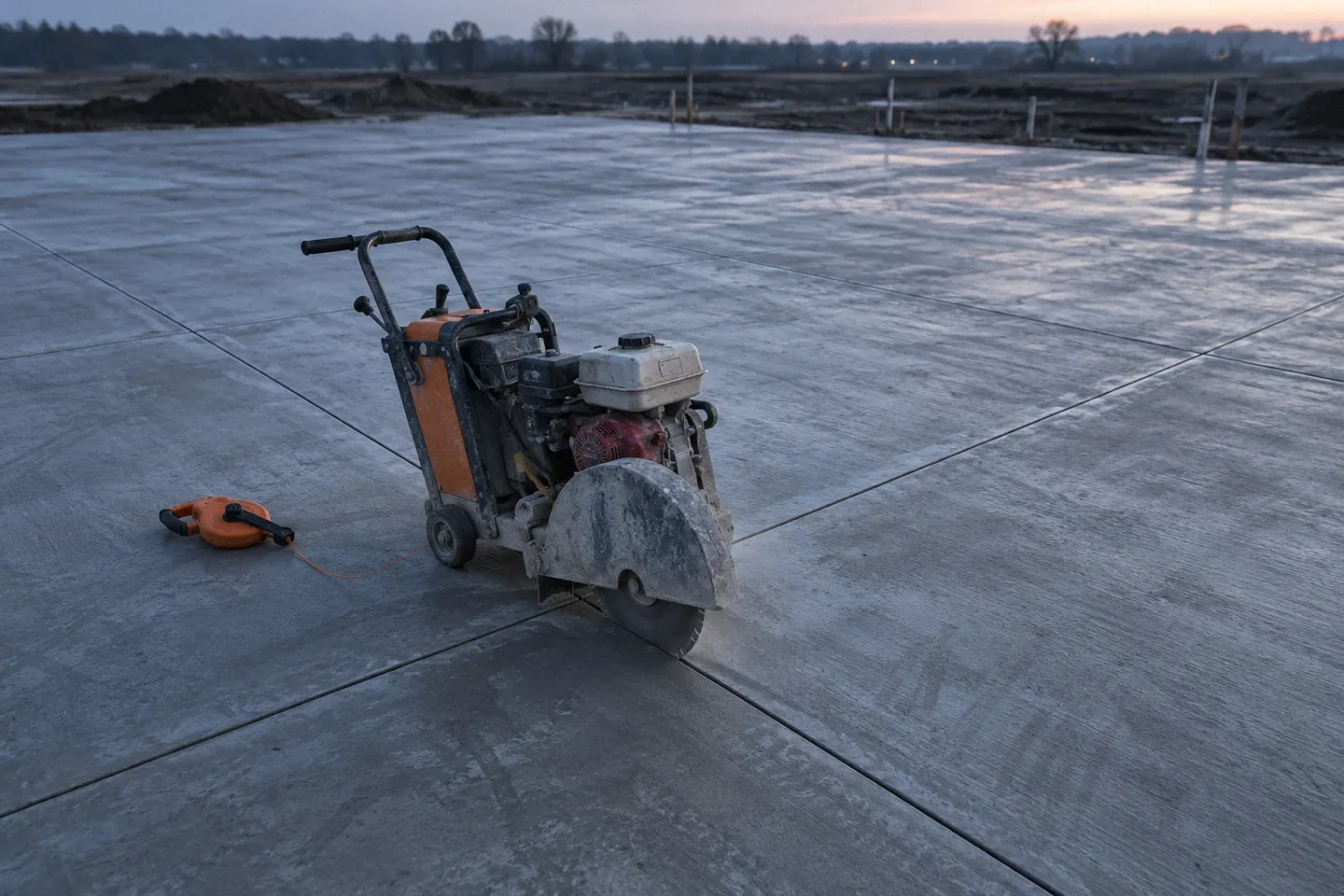
A saw-cutting plan should exist before the concrete is placed. Otherwise, the crew finishes the slab and only then asks when a saw can be obtained, who will operate it, and where the cuts belong. The resulting delay is a scheduling problem created before any blade touches the surface.
A Reddit owner asked about cutting joints ten days after placement. That discussion demonstrates why owners need the cutting plan early. This article addresses planning the window for new work, rather than diagnosing whether late or shallow cuts caused an existing crack.
Use the correct joint name
A contraction joint is intended to establish a planned weakened plane. Isolation and expansion details serve different purposes and are not created merely by making a shallow saw cut.
NRMCA CIP 6 explains joint types, layout, depth, and timing. Use the actual project detail when specifying the work rather than calling every visible groove an “expansion joint.”
This terminology affects the conversation. A request to “add expansion joints later” may conceal uncertainty about both the desired function and the required construction.
Decide the layout first
Show the intended joints on a plan. Consider the slab shape, changes in geometry, openings, and relationships to adjacent construction through the applicable design.
Do not leave a decorative pattern to override the functional joint plan without review. A line that looks attractive in a rendering is not automatically a suitable joint location.
The crew also needs to know which joints will be tooled, formed, saw-cut, or otherwise detailed. A mixed approach should be intentional and clearly communicated.
Choose the saw system and depth
Early-entry and conventional cutting are not identical processes. The equipment, blade, required depth, and surface condition need to fit the selected method.
CIP 6 gives general timing guidance, including early-entry cutting commonly one to four hours after finishing and conventional cutting commonly later in the same early period. These are planning ranges, not a guarantee for every mixture or weather condition.
The document also discusses minimum depth for conventional contraction joints and different early-entry considerations. Follow the specified detail and equipment guidance instead of assuming one depth applies to every saw system.
Understand the cutting window
The objective is to cut when the operation can produce an acceptable joint without waiting so long that the intended control is lost. The exact window changes with the concrete and conditions.
A cool morning, a hot afternoon, a different cementitious mixture, or an admixture change can alter the schedule. The finishing completion time also matters; calendar labels such as “same day” can hide very different elapsed periods.
Assign someone to monitor readiness. A saw available only at a convenient time is not the same as a saw available during the appropriate window.
A hypothetical Friday pour
Imagine a slab finished late Friday afternoon. The installer usually returns the next morning, but the rental saw is reserved elsewhere on Saturday. The owner assumes Monday will be acceptable because the concrete will be harder.
The planning error is visible before the pour begins. Equipment availability and staffing must match the cutting requirement. The team should arrange the correct saw and operator or revise the placement schedule.
Now suppose a suitable early-entry system is available Friday. That still does not authorize arbitrary cutting immediately after the last finishing pass. The operator must assess conditions and use the system correctly.
The example shows that both logistics and material readiness need to align.
Record the plan in a small checklist
| Item | Decision required |
|---|---|
| Layout | Approved joint positions and intersections |
| Method | Tooled, early-entry, conventional, or specified alternative |
| Depth | Required detail for the selected system |
| Equipment | Saw and blade suited to the application |
| Staffing | Named operator and availability |
| Monitoring | Who checks the concrete's readiness |
| Weather change | How the schedule will be reassessed |
Keep the plan where the crew can use it. A detail buried in an email that the operator never sees is not effective coordination.
Do not make the first production cut a blind experiment
The operator should understand the blade and equipment requirements and assess whether the surface is ready. If the cut is producing an unacceptable result, stop and evaluate the cause rather than continuing across the entire slab.
This does not mean every visible imperfection proves the timing was wrong. Equipment, blade condition, mixture, and other factors can also matter. Planning should include a responsible response to unexpected cutting behavior.
For existing post-tensioned or otherwise structurally sensitive concrete, cutting is a separate investigation and design question. Do not transfer new-slab contraction-joint guidance to unknown existing construction.
Coordinate cleanup and curing
Sawing is part of the construction sequence, not an isolated visit. Plan how the operation interacts with curing materials, site access, and subsequent work.
Identify the required cleanup method and how the finished surface will be protected. Do not assume a worker returning later will know which areas are ready for traffic or what curing system was applied.
Retain the joint plan and basic timing records. They document the intended work without pretending that photographs alone establish every dimension or condition.
Coordinate a separate cutting crew
If a separate saw-cutting subcontractor is involved, give that crew the placement schedule, mixture information, joint drawing, and contact for condition updates. Confirm that a changed finishing time reaches the operator directly. A booking that says only 'Saturday morning' can fail even when both contractors intend to do good work, because neither has assigned responsibility for communicating the actual cutting window.
Frequently asked questions
Is next-day cutting always acceptable?
No. Plan around the actual concrete and saw system, with monitoring and equipment available during the appropriate window.
Are saw-cut grooves expansion joints?
Usually the planned shallow cuts discussed here are contraction joints. Confirm the intended function and detail rather than using the terms interchangeably.
Research references
- primary · full
NRMCA CIP 6 Joints in Concrete Slabs on Grade - reddit · search-excerpt
Okay to cut expansion joint after 10 days of curing?