- Compare physical finish samples
- Review use and maintenance
- Approve layout and appearance
Reddit discussions identify questions; technical guidance comes from the linked primary sources. This article is not a site inspection or an engineered specification. How we research.
Stamped concrete and exposed aggregate can both make an attractive patio, but they are not interchangeable looks applied to an otherwise identical surface. They involve different processes and can produce different tactile experiences.
A Reddit owner comparing the two patio finishes asked about longevity, children, traction, and decorative borders. Those are better comparison criteria than declaring one finish universally superior. The right choice depends on the finished surface and how the space will be used.
Understand the basic visual difference
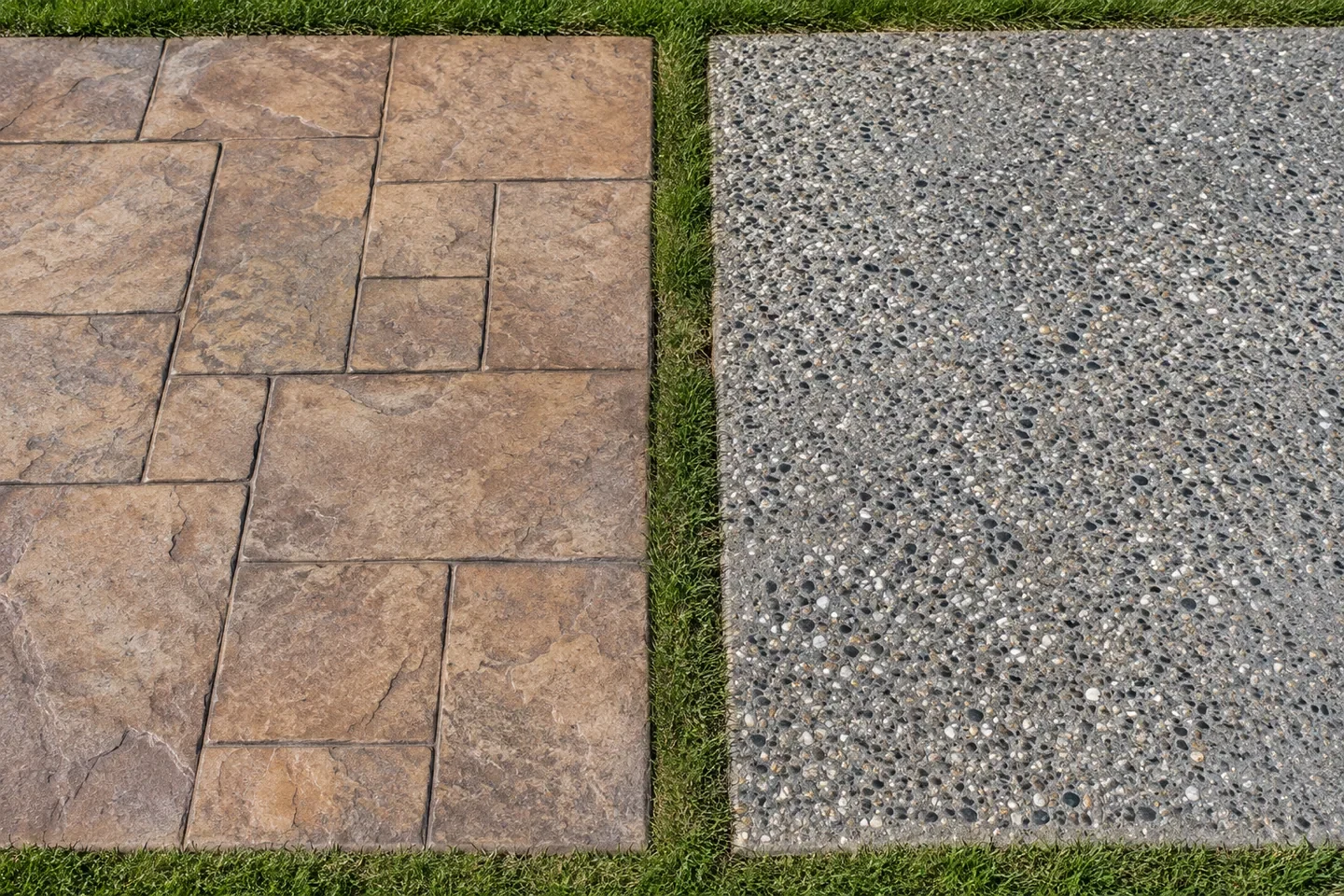
Stamping uses tools to imprint a pattern or texture in suitable fresh material. Exposed aggregate reveals selected aggregate at the surface through an appropriate process. Sika's patterns-and-textures guidance distinguishes those approaches.
A stamped pattern may imitate stone, brick, or another material. Exposed aggregate emphasizes the actual particles and surrounding matrix. Neither category determines one exact color, roughness, or maintenance requirement.
Ask which specific system the contractor proposes. A broad category name cannot describe every possible product and finishing sequence.
Examine samples with your intended use in mind
Look at the sample from standing height and at close range. Touch it and, where practical, assess how it feels under the conditions in which the patio will be used.
A photograph can show pattern scale and color relationships, but it cannot reliably communicate tactile texture. Screens and lighting also affect color interpretation.
For a family patio, consider bare feet, chair movement, small wheels, cleaning, and wet conditions. If a specific slip-resistance requirement applies, use the appropriate project testing and evaluation rather than relying on a product adjective.
Compare the whole installed system
The final surface may include coloring, release materials, curing products, and sealers. Ask what will actually be used and how those choices influence appearance and maintenance.
Sika's exposed-aggregate product guidance calls for a representative jobsite sample and evaluation of the completed surface, including wet and dry slip resistance. The practical point is to approve the finished system, not just raw concrete.
Do not assume the unsealed sample on a display rack will match a sealed production surface. Confirm which state you are comparing.
A hypothetical family decision
Imagine an owner initially prefers a detailed stamped pattern because it resembles stone in photographs. Their second choice is a fine exposed-aggregate finish with a contrasting border.
At a sample review, the stamped texture has deeper recesses than expected, while the exposed sample feels less coarse than the owner assumed. The family also notices how outdoor chair legs interact with each surface.
They discuss cleaning, color variation, and maintenance with the installer. The final selection may still be stamped concrete, but it is now based on the actual surface rather than a stereotype about each category.
This is a hypothetical selection exercise, not a claim that either finish performs better in all households.
Use a comparison sheet
| Criterion | Stamped proposal | Exposed-aggregate proposal |
|---|---|---|
| Exact system | Pattern, color, release, finish products | Aggregate, exposure, finish products |
| Physical sample | Texture and relief depth | Particle feel and exposure depth |
| Joint coordination | Pattern relationship | Field and border relationship |
| Wet-use assessment | Completed system | Completed system |
| Maintenance | Written product-specific expectations | Written product-specific expectations |
| Future repair appearance | Discuss realistic limitations | Discuss realistic limitations |
Fill the sheet from the contractor's actual proposal. Do not insert generic maintenance intervals or lifespan claims without supporting information.
Coordinate joints before selecting the pattern
Functional joint planning remains necessary. Decorative lines may influence the visual layout, but they should not silently replace the required joint detail.
Ask to see the proposed pattern and joint plan together. A border, step, or curved edge can create an awkward intersection if reviewed only after placement.
Where two decorative treatments meet, clarify the construction sequence. A combined stamped-and-exposed design may require more coordination than either finish alone. That additional work should be visible in the scope.
Evaluate the installer's relevant experience
Ask to see comparable completed work using the proposed system. A contractor experienced with ordinary broom-finished slabs may not have the same process controls for decorative work.
Look for a clear explanation of sample approval, placement sequence, protection, and final treatment. Attractive photographs are useful, but they do not replace a reviewable plan.
Avoid demanding a perfect copy of a project made with different aggregate, mixture, lighting, or products. Use the reference to communicate intent, then approve a sample representative of your own work.
Make maintenance expectations concrete
Ask which products will be used and what care their manufacturers require. Clarify who provides the initial treatment and whether future maintenance is part of the quote.
Do not treat “low maintenance” as “no maintenance.” Equally, do not invent a fixed resealing schedule independent of the product and exposure.
Retain the product names and application records. Future maintenance is easier when the next contractor knows the existing system instead of trying to identify it from appearance.
Choose the surface you have actually evaluated
The final decision should combine appearance, touch, use, maintenance, and a credible installation process. A physical sample often resolves questions that hours of image browsing cannot.
Approve the system, sample, and layout together. That gives the installer a coherent target and gives the owner a realistic understanding of what is being purchased.
Check pattern scale in the actual space
Consider the size of the pattern or aggregate field relative to the patio. A large imitation-stone pattern may show only a few complete units in a narrow space, while a border can occupy more of the surface than expected. Mark the proposed layout at full scale before approving it. This inexpensive check addresses proportion and furniture placement without pretending to predict material performance.
Frequently asked questions
Is exposed aggregate always uncomfortable barefoot?
No. The specific aggregate and exposure matter. Inspect a representative completed sample.
Can a stamped pattern hide the need for joints?
No. Coordinate functional joints with the decorative design before placement.
Research references
- primary · search-excerpt
Sika Patterns and Textures - primary · search-excerpt
Sika LITHOCAST Surface Retarder - reddit · search-excerpt
Exposed Aggregate vs Stamped concrete