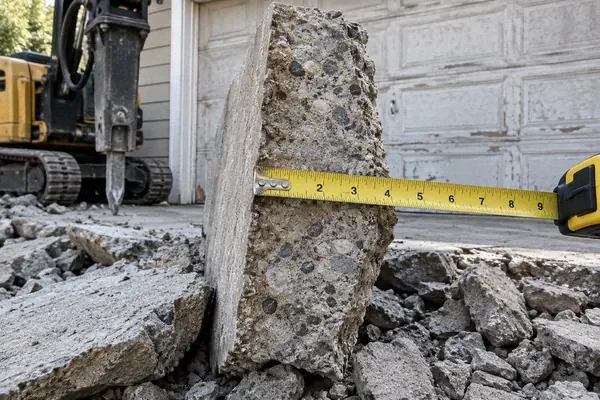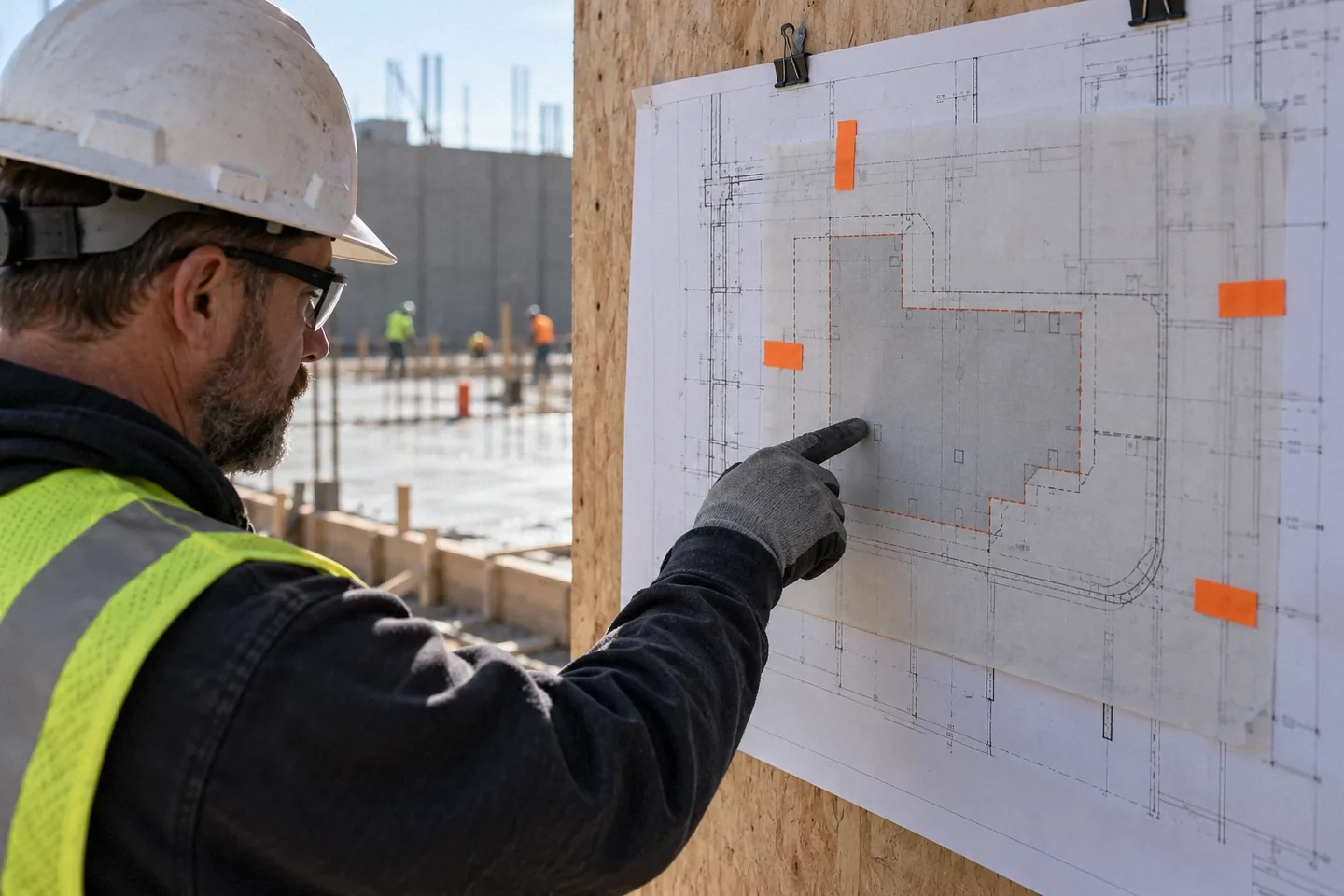
- Describe the changed work
- Price additions and credits
- Authorize the revised scope
Reddit discussions identify questions; technical guidance comes from the linked primary sources. This article is not a site inspection or an engineered specification. How we research.
Identify the reason for the change
Start with one factual sentence. Examples include an owner requesting a wider patio, excavation exposing an undocumented obstruction or the contractor reporting that its original measurement was wrong. Those events may have different contract consequences. Calling all of them “extras” conceals the question that needs to be resolved.
Compare the request with the accepted proposal and drawing. Mark the original boundary and the proposed boundary. If the work is not changing at all, ask why a change order is being proposed. You may have a pricing dispute rather than additional scope. Do not treat a new invoice as proof that the original agreement changed.
California requires written changes for covered home improvement agreements, as discussed in CSLB's contract guide. Other jurisdictions and contract types need their own review; this is not a universal ruling about enforceability.
Give the changed work a physical description
A useful description identifies the location, quantity or boundaries, operation and related details. “Add concrete” is insufficient if the change also requires more removal, altered drainage, a new edge or a revised permit plan. Ask what existing work must be redone and what previously priced work will no longer occur.
Include credits as well as additions. If the owner substitutes a smaller area or removes a finish option, the written revision should show the corresponding adjustment. A document that records only increases can leave both parties unable to reconstruct the final scope and total.
Use a revised sketch where it clarifies the work. Label it with a date and revision number. Avoid circulating several unlabeled screenshots that show slightly different dimensions. The person setting forms should be able to identify which version is approved without interpreting the owner's messaging history.
Price the whole effect before approving
| Element | Question to settle |
|---|---|
| Added work | What operation or quantity is newly included? |
| Deleted work | What previously priced item is removed or reduced? |
| Rework | What completed work must change, and why? |
| Time | Does the revision affect placement, inspections or completion? |
| Payment | When is the added or reduced amount reflected in the schedule? |
| Approval | Who is authorized to accept the revision? |
A unit price can be useful when the final quantity cannot be known immediately, but it needs a measurement method and an agreed process for reporting the result. Ask whether equipment, transport and disposal are already included. Otherwise, the owner may believe a unit price covers the entire change while the contractor expects several additional charges.
If a final price cannot yet be established, identify what investigation is authorized and any agreed limit for that investigation. Do not describe a broad, unknown repair as a fixed-price change merely because both parties want the project to keep moving.
Avoid approval by ambiguity
An owner saying “I understand” may mean they understand the problem, not that they approve an extra charge. A contractor saying “we will take care of it” may mean an assessment, not free replacement. Follow the discussion with a written summary that distinguishes acknowledgment, proposed work and authorization.
Use the approval method required by the agreement and applicable law. The goal is not to produce paperwork for its own sake. It is to ensure that the person paying and the person performing the work accept the same revision before irreversible work begins.
A Reddit account of a large retrospective retaining-wall increase raises exactly this timing problem. It is an unverified dispute, not a legal precedent. The useful lesson is to document a proposed revision when it arises rather than reconstruct the discussion months later.
Hypothetical example: a wider patio and an unrelated cost increase
Suppose an owner asks to add a narrow seating strip beside a planned patio. The contractor prices the extra area and notes that the revised layout needs another inspection review. That is a defined proposed change the owner can accept, reject or redesign.
At the same meeting, the contractor says the original labor estimate was too low and asks for an additional amount unrelated to the strip. The owner separates the two items. Approval of the seating strip does not automatically mean agreement that the original labor underbid should be transferred to the owner.
The parties review the fixed-price terms and obtain advice if they cannot resolve the second issue. Keeping the requests separate prevents a valid new scope decision from becoming accidental acceptance of an unrelated disputed charge.
Maintain a running revision register
Number the changes and record their status: proposed, declined, approved or superseded. Keep a running contract total showing the original price, approved additions, credits and payments. Give the crew the current scope without deleting the history that explains how it changed.
When an urgent site condition arises, establish what must be secured immediately and what can wait for review. Emergency protection and permanent revised construction are not necessarily the same authorization. Document the immediate condition and obtain qualified direction where safety or structural work is involved.
Is a contractor's measurement error automatically an approved extra?
No. It identifies an issue to review against the contract and applicable law. Do not assume either party's financial responsibility solely from the fact that a later measurement is different.
Can I approve a change by text?
That depends on the agreement and governing requirements. Use the required process and make the scope, price and authority clear; a short conversational reply may leave essential terms unresolved.
Keep each change small enough to describe and complete enough to price. When the work, money and authorization are all visible in the same record, both parties can make a deliberate decision.
Research references
- primary · full
FTC: How To Avoid a Home Improvement Scam - primary · full
CSLB: Terms of Agreement - reddit · search-excerpt
Contractor misquote and work stoppage - reddit · search-excerpt
30k over original quote