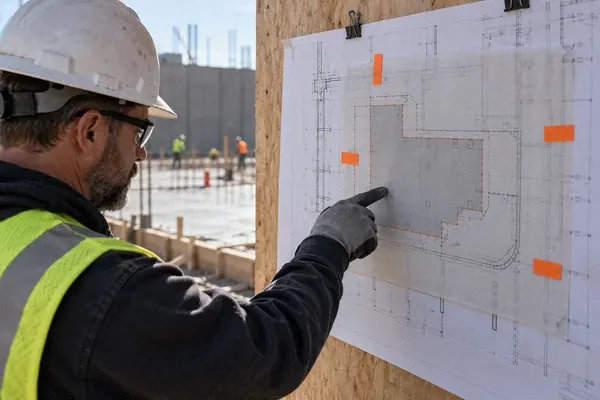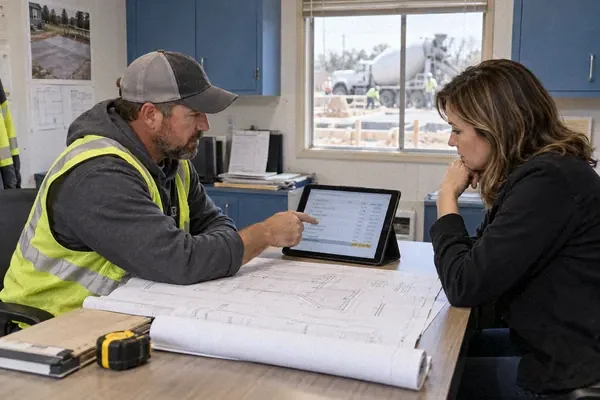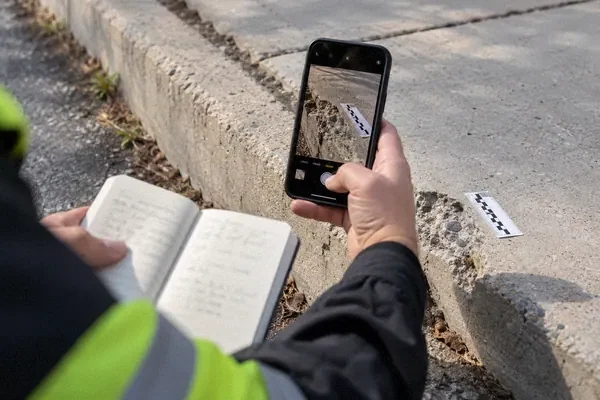
- Record the exposed condition
- Compare the bid assumption
- Approve the removal revision
Reddit discussions identify questions; technical guidance comes from the linked primary sources. This article is not a site inspection or an engineered specification. How we research.
Preserve what was discovered
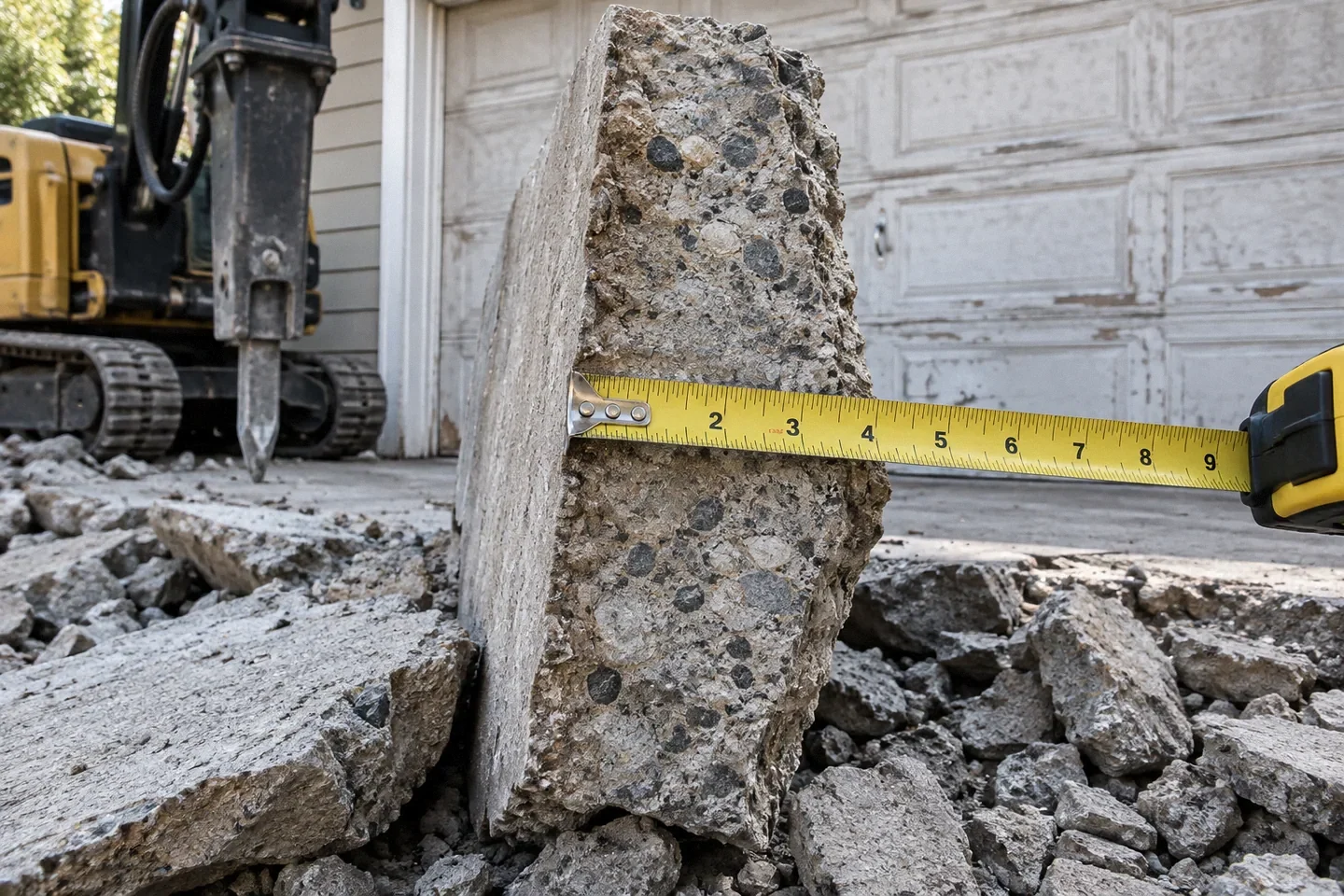
Ask the contractor to identify the location and extent of the unexpected condition. An exposed edge with a ruler can show thickness at that point. It does not prove that the entire driveway has the same section. Photograph the overall area, the measured location and any visible reinforcement or obstruction without entering an unsafe work zone.
Record when the discovery occurred and what work had already been completed. If the contractor continues removing the area before discussing the issue, later quantities may become harder to verify. Agree on a way to document the condition while keeping the site secure and allowing any necessary protective work.
A Reddit contractor described finding much thicker reinforced concrete during driveway removal. The post illustrates an estimating uncertainty. It does not establish a universal right to charge the owner for every difficult demolition condition.
Read the actual assumption
Find the language in the accepted proposal. Does it identify assumed thickness, reinforcement, removal limits or access? Is demolition a fixed amount, a measured quantity or an allowance? Did the owner provide drawings that the contractor relied on? The answer affects how the parties should discuss the discovery.
Avoid inventing a limitation after the fact. If the proposal simply says removal of the marked driveway, the contractor and owner may disagree about what risk that includes. That disagreement deserves contract review, not a hurried verbal decision made beside operating equipment.
For California home improvement work, CSLB's contract guidance addresses written changes. Use the applicable process for your location and agreement rather than assuming a Reddit business practice controls.
Separate the cost components
A thicker slab can affect several parts of a removal proposal, but each claimed effect should be identified. Ask what additional equipment, labor, hauling or disposal is proposed and how the amount was calculated. Do not require the contractor to expose every internal business detail; do require a clear description of the change you are being asked to purchase.
If a quoted unit rate applies, check its unit. Area, volume, weight and equipment time are different quantities. A rate per square foot cannot be compared directly with a disposal ticket measured by weight. Ask how the measured field condition is translated into the invoice.
Also ask what remains included in the original price. Otherwise, a revised demolition charge may inadvertently bill the same loading or mobilization twice. A concise original-versus-revised comparison is often enough to reveal whether the new figure is a total replacement price or an addition.
A removal-change checklist
| Evidence or decision | Why it matters |
|---|---|
| Marked location of discovery | Prevents one unusual edge from representing the entire site |
| Safe photographs with scale | Preserves the observed condition before it disappears |
| Original scope and assumptions | Establishes what was actually priced |
| Proposed measurement method | Makes the final quantity reviewable |
| Added operations and credits | Shows the net change rather than an unexplained total |
| Schedule and approval | Clarifies what work may proceed and when |
Ask whether investigation should precede pricing the entire remaining area. Limited additional observation may establish that the thick section is local. In another case, the condition may continue throughout the work. Do not authorize uncontrolled exploratory demolition simply to resolve a pricing question.
Hypothetical example: a thickened edge
Suppose a contractor exposes a thick section along one side of an old driveway and requests an increase based on that thickness across the entire area. The owner asks for the measured locations and the basis for extrapolating. Further safe observation shows that the unusual section is concentrated at the edge.
The revised proposal prices the additional effort for that strip and keeps the remaining work under the original scope. In another project, observations might support a broader revision. The important distinction is between an actual measured condition and an assumption about unexposed work.
The example does not suggest that owners should direct demolition methods or stand near machinery. Their role is to obtain an understandable record and agree on the commercial decision. The contractor and relevant professionals remain responsible for safe methods and any required technical assessment.
Do not trade away needed work to preserve the number
An owner may respond to an increase by asking the crew to leave part of the slab, reduce preparation or pour over what remains. That is a different construction proposal, not merely a discount. It needs its own evaluation for the intended use, design and approvals.
Similarly, debris should not be buried or moved into an unapproved location simply to avoid hauling cost. Ask for a lawful disposal plan consistent with the project requirements. If the alternatives materially change the finished work, request separate descriptions and prices so the decision is explicit.
Keep the discovery discussion factual. A contractor can encounter a genuine unknown without having acted dishonestly. An owner can question the proposed charge without denying that the work became harder. The contract and evidence should guide the decision rather than either party's frustration.
Does a photograph of one thick edge prove the whole slab is thick?
No. It establishes what was visible at that location. Ask how the remaining quantity will be verified before accepting a price based on the entire area.
Should I agree to the extra charge so the crew keeps working?
Only after you understand the revised scope and payment basis. If responsibility is disputed, document the issue and obtain appropriate contract advice instead of treating schedule pressure as agreement.
The next step is a measured, written revision or a clearly documented disagreement. Preserve the condition, identify the pricing assumption and decide what work is authorized before the evidence is hauled away.
Research references
- primary · full
FTC: How To Avoid a Home Improvement Scam - primary · full
CSLB: Terms of Agreement - reddit · search-excerpt
I bid a job low and unexpected costs