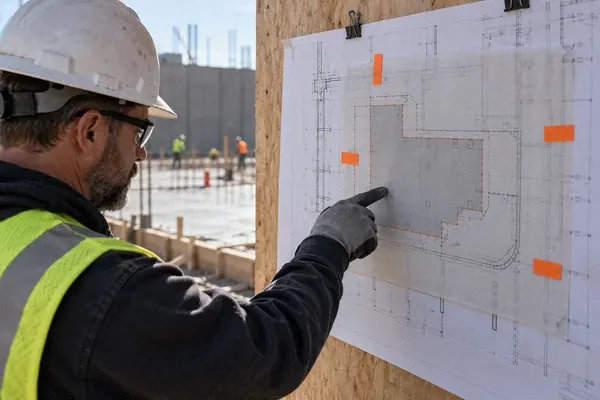
- Define the physical scope
- Assign decisions and changes
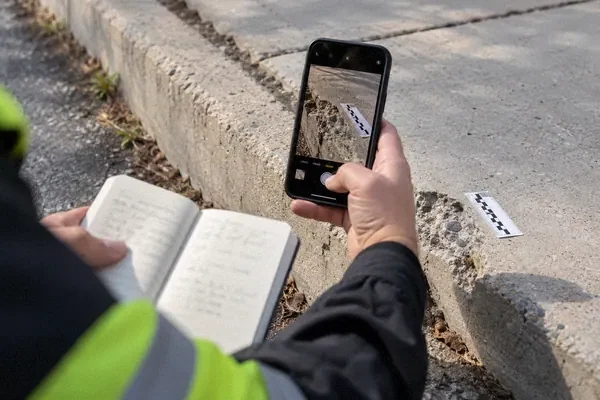
- Describe finished work
Reddit discussions identify questions; technical guidance comes from the linked primary sources. This article is not a site inspection or an engineered specification. How we research.
Make the project recognizable
Begin with the property and the exact areas included. Attach a marked plan or sketch with dimensions, reference points and labels for existing surfaces. If work stops at a particular fence, joint or garage threshold, identify that boundary. “New driveway” is too broad when one person means the parking area and another includes the public apron.
State the intended use and identify the controlling design documents. A foundation, driveway and decorative patio should not share a vague specification copied from an unrelated project. If the work depends on professional design, name the document and revision rather than inserting an owner's guess about reinforcement or concrete strength.
California's CSLB contract guide emphasizes written project detail. Its legal requirements apply in California; this article's organization is a planning aid, not a substitute contract for every state.
Name the operations, not just the finished appearance
Separate removal, preparation, placement and completion. If existing concrete is to be removed, say which sections. If a coating or overlay is proposed, call it that. The words “repair,” “restore” and “replace” should not be used interchangeably when they describe different operations and results.
A Reddit dispute about a promised replacement illustrates the communication problem. The homeowner's allegations do not establish what technically should have been done, but they show why a contract should identify whether the original slab remains.
Include access and restoration. Who moves planters or gates? Where may equipment travel? What happens to irrigation or landscaping disturbed by the agreed work? Make decisions about known obstacles before the crew arrives. List genuinely unknown conditions and the process for addressing them rather than pretending the site contains no uncertainty.
Specify appearance without promising an exact photograph
Record the selected finish, edge treatment, color system and any approved sample. Identify whether the sample is a small mockup or a photograph of another project. Ask the contractor to explain which visual characteristics can vary and how the owner will approve the selection.
A photograph may show lighting, wetness, sealer age or surrounding materials that your site will not duplicate. The agreement should describe the chosen product and workmanship expectations rather than promise an impossible pixel-for-pixel match. If appearance is a major purchasing criterion, decide whether a project-specific mockup is warranted and who pays for it.
Do the same for layout. Show intended joints, borders and transitions when those features affect the design. A brief review of the layout before placement can prevent an expensive disagreement after the pattern is permanent.
Build the contract around decisions
| Contract question | Useful written answer |
|---|---|
| Who can approve an owner change? | Named owner contact or authorized representative |
| Who communicates for the contractor? | Named project contact and backup |
| How are unknown conditions handled? | Notice, evidence, revised scope and approval procedure |
| What triggers a payment? | Identifiable milestone and invoice basis |
| What counts as completion? | Remaining work, cleanup, records and applicable approvals |
| How are concerns reported? | Contact method and written follow-up process |
Do not let a text message from someone without authority become the only record of a costly change. If multiple family members make decisions, identify one approval process before work starts. The contractor should likewise explain who can change the scope or price on the company's behalf.
Separate promises from assumptions
A contract can contain both a commitment and an assumption, but they should be recognizable. “Remove the marked slab” describes promised work. “Price assumes the documented existing thickness and no concealed obstruction” describes a condition affecting that promise. Ask what happens if the assumption proves wrong.
Avoid blank spaces and references to documents you have never received. If the agreement incorporates a proposal, drawing or terms sheet, obtain the actual version before signing. Save a complete signed set, including the reverse side of printed pages and all attachments. Keep revised copies clearly dated.
Review the price and payment schedule as part of the same package. A beautifully detailed scope can still produce a dispute if the payment clause uses undefined words such as “substantially done.” Ask how that phrase relates to the specific remaining tasks on your project.
Hypothetical example: the missing connector
An owner and contractor discuss a patio with a narrow connector to a side door. The estimate says “rear patio,” and the owner's sketch shows the connector in a different color. Before signing, they discover that the contractor priced only the main rectangle.
They revise the drawing, add the connector's treatment and adjust the price. They also identify the gate that must be removed for access and who reinstalls it. Neither party needed a confrontation or a legal theory. They needed a document that captured the same physical job.
The example also shows why oral agreement alone is difficult to administer. Once the work begins, memory of a brief site conversation may differ even when both parties acted honestly.
Can I use the estimate as the contract?
Sometimes the signed proposal is part or all of the agreement, but its adequacy depends on its contents and applicable law. Check that it includes the required terms and attachments rather than assuming the document title settles the question.
Should the contract include every possible hidden problem?
No one can list every site condition in advance. It should identify known uncertainties and provide a workable notice and approval process for discoveries that affect the scope, cost or schedule.
Before signing, ask a person unfamiliar with the discussion to read the documents and describe the promised job. Any major difference between their understanding and yours points to a clarification worth making now.
Research references
- primary · full
FTC: How To Avoid a Home Improvement Scam - primary · full
CSLB: Terms of Agreement - reddit · search-excerpt
Am I being scammed? Was told this was a $9,500 job to replace and strengthen - reddit · search-excerpt
Contractor misquote and work stoppage