- Define the accessible route
- Review transitions and surface
- Plan ongoing maintenance
Reddit discussions identify questions; technical guidance comes from the linked primary sources. This article is not a site inspection or an engineered specification. How we research.
Identify the route and its purpose
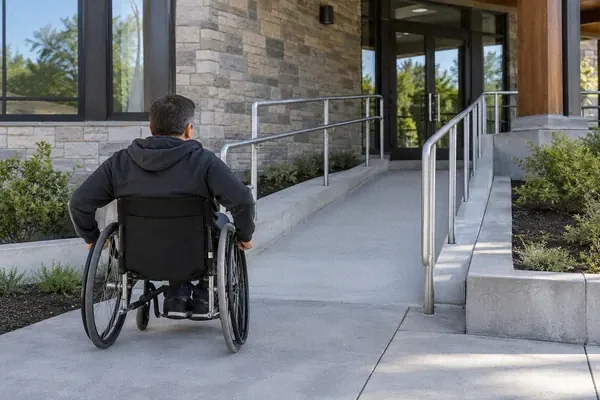
Mark the beginning, destination and connections on a plan. A route from parking to an entrance may include an access aisle, curb transition, walkway and door approach. Fixing one segment while leaving an obstacle at the next connection can leave the overall journey unresolved.
Ask who uses the route and how it functions during ordinary activities. Deliveries, parked cars, planters and open gates can affect the available path even when the concrete itself looks suitable. Include those conditions in the assessment rather than evaluating an empty site photograph alone.
A Reddit wheelchair ramp planning discussion demonstrates how often attention concentrates on slope. The question is useful context, but a complete route review must address more than the incline of one section.
Apply the right standards to the right site
The U.S. Access Board's floor and ground surface guide explains ADA provisions for covered surfaces. It addresses stability, firmness, slip resistance, openings and changes in level. Applicability must be established; a private home path should not automatically be described as subject to every ADA provision.
Ask the relevant authority and qualified design professional which federal, state and local requirements govern the project. Public right-of-way work, commercial property and private residential work can involve different frameworks. A Florida project should not borrow a California detail without that review.
Where the standards apply, use the current official documents and project design. Do not rely on a simplified internet rule that treats every joint, slope and threshold as the same feature.
Examine transitions rather than only broad areas
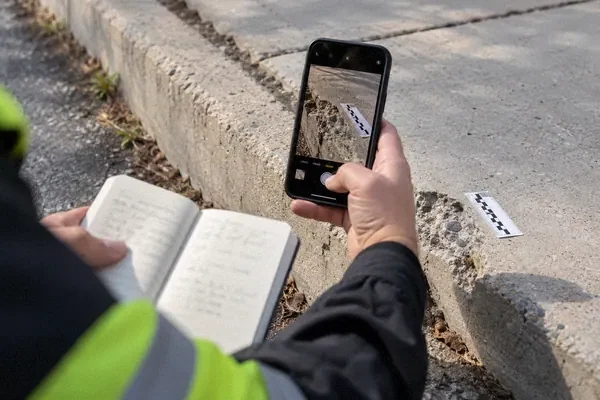
Walk or assess the route from one connection to the next. Note changes between old and new concrete, pavement and grates, the walkway and landing, and the landing and threshold. Record each location so a designer or contractor can assess the actual geometry.
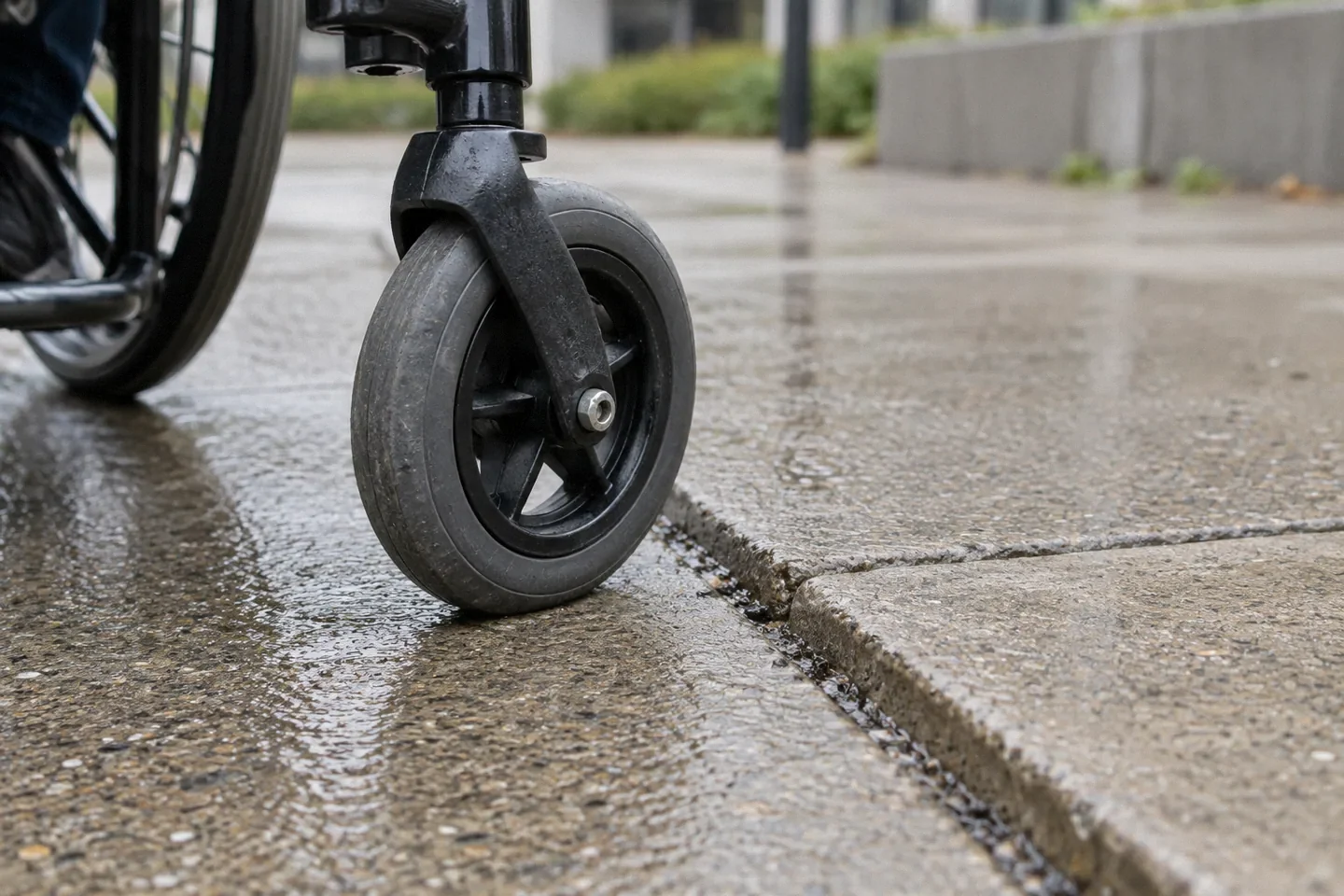
A close photograph of a joint may not reveal the surrounding slope or direction of travel. Provide context and appropriate measurements through the responsible assessment process. Avoid declaring a trip hazard harmless because one dimension appears small in a picture.
If corrective work is proposed, ask how it affects the neighboring surfaces. Grinding, replacement or another method may change appearance, drainage or a transition. The appropriate remedy should follow the site assessment and applicable requirements, not a universal repair recipe.
A route review worksheet
| Location | Observation to document | Question for the reviewer |
|---|---|---|
| Old-to-new connection | Visible offset or gap | What treatment is appropriate under the governing requirements? |
| Drain or grate | Opening and orientation in the route | Is the selected detail suitable for this location? |
| Door approach | Surface and available maneuvering area | Does the complete entry function as designed? |
| Sloping segment | Direction and context of slope | Is it a walking surface, ramp or another defined element? |
| Wet area | Recorded water and surface condition | What drainage or finish review is needed? |
Do not use the worksheet as a substitute for professional measurements. Its purpose is to make the concerns clear enough that the right person can evaluate them efficiently.
Slip resistance is not one universal number
The Access Board explains that ADA standards do not specify a universal minimum coefficient of friction. A product's laboratory rating therefore should not be presented as an automatic compliance certificate for every installed walkway. Review the method, application and expected conditions with the appropriate professional. See the official surface guide.
Ask how the finish will be selected and maintained. A treatment that changes the surface should be evaluated for the route's use, including wheeled mobility, rather than chosen solely for appearance. Do not assume a rougher surface is always the better practical outcome.
The Access Board ramp guide also addresses wet conditions for covered ramps and landings. Keep those provisions within their proper scope instead of using them as a blanket drainage standard for every private patio.
Hypothetical example: a new walkway with an old bottleneck
Suppose a business replaces a walkway segment with new concrete and calls the route accessible. At the entrance, an existing transition and door approach were excluded from the work. A user can travel along the new section but still has difficulty reaching and operating the door.
A complete route review identifies the excluded connection and the applicable requirements. The owner then obtains a coordinated proposal rather than adding an improvised patch at the end of the new slab. The issue was not simply the finish of the new concrete; it was the incomplete scope of the route.
The example shows why an accessibility claim should be tied to a defined assessment of the whole intended path. A contractor's completion of one priced segment does not establish every other part of the route.
Make maintenance part of the record
Ask who monitors the route for changing conditions, obstructions and surface deterioration. Keep the original design and completion documentation so later repairs can be evaluated against the intended arrangement. A replacement joint treatment or coating should not be selected without considering its effect on the route.
Document concerns with location photographs and notify the responsible property contact. Avoid placing an obstacle in the route as a warning without considering how users will pass it. Temporary measures should be planned with the relevant professionals and property responsibilities in mind.
Does smooth concrete automatically make a walkway accessible?
No. The complete route, transitions, geometry and applicable requirements still need review. A smooth surface can coexist with an unusable door approach or another unresolved connection.
Can a slip-resistance product label prove ADA compliance?
Not by itself. The Access Board does not specify one universal coefficient, and the installed surface and applicable route requirements need to be evaluated in context.
Assess the route from start to destination and record each transition. That produces a more useful improvement plan than treating accessibility as a label attached to one finish or one slab.
Research references
- primary · full
Access Board: Floor and Ground Surfaces - primary · full
Access Board: Ramps and Curb Ramps - reddit · search-excerpt
Edit: Concrete Ramp for Wheelchair - reddit · search-excerpt
Help: Wheelchair ramp implementation