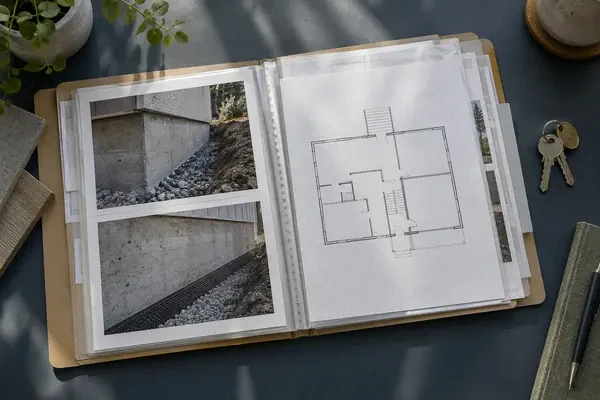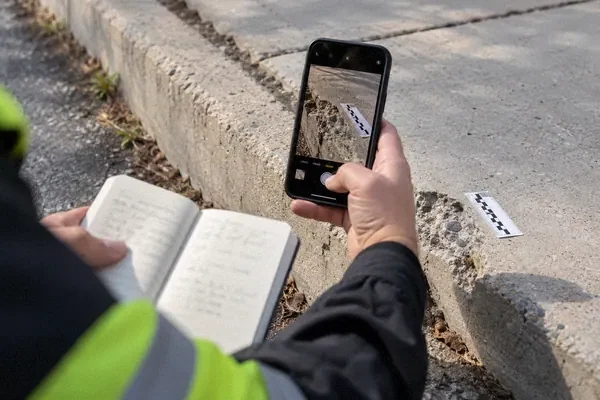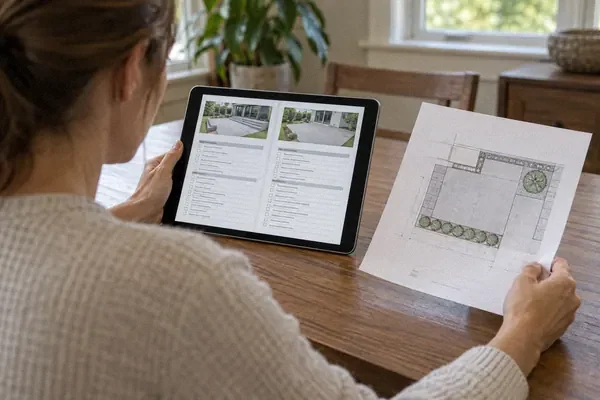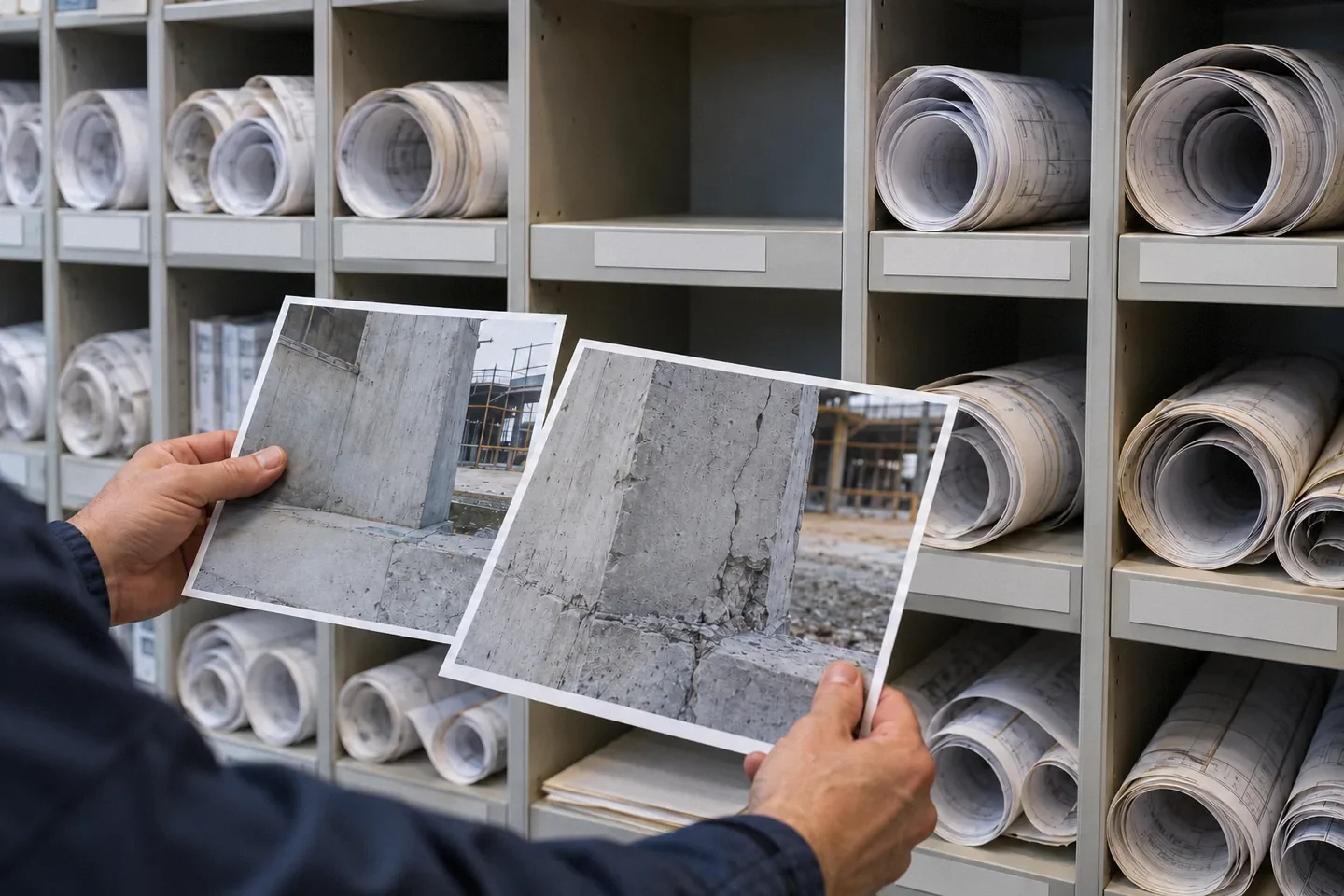
- Confirm the property identifiers
- Request the complete record
- Build a dated evidence timeline
Reddit discussions identify questions; technical guidance comes from the linked primary sources. This article is not a site inspection or an engineered specification. How we research.
Start with the right property and authority
Verify the parcel, address and jurisdiction. Older records may use a previous address, a related building permit or a filing system not fully represented in a public portal. Ask the authority how its records are organized before treating one unsuccessful search as definitive.
Describe the work you are investigating: driveway replacement, a garage slab, an addition's foundation or another operation. Include the approximate construction period if known and explain the basis for that estimate. A request for “all concrete permits” may not match the way the agency categorized the project.
A Reddit buyer reported an unsupported addition and no permits found online. The account raises serious questions but does not establish another property's history. It demonstrates why permit research and physical assessment should proceed as separate, connected inquiries.
Ask for the complete record, not just a status label
Request relevant applications, issued permits, approved plans, revisions, inspection results and closure records as available. A permit number alone does not show which work it covered or whether all required steps were completed. Read the scope and dates with the authority when the meaning is unclear.
The City of Orlando's engineering permit page and residential requirements illustrate a local process for specified driveway and related work. They do not establish that every concrete operation in every Florida jurisdiction requires the same permit.
If the work is older, ask which requirements applied to the relevant scope and time. Do not use a current webpage alone to declare a historical violation. That determination belongs with the appropriate authority and, where disputed, qualified legal advice.
Keep four questions separate
| Question | Relevant evidence |
|---|---|
| What work exists? | Site assessment, measurements and available plans |
| When was it performed? | Dated invoices, photographs, records and reliable testimony |
| What approvals were required or obtained? | Authority response and complete permit history |
| What did a particular person know? | Communications and other evidence reviewed under applicable law |
These questions may overlap, but one does not automatically answer the others. A physical defect does not prove a missing permit. A missing permit does not prove that the current seller performed the work. A seller's ownership during a period does not by itself establish knowledge of every concealed condition.
Build a timeline with confidence labels
Use exact dates from records where available. Mark estimated dates as estimated and state the source, such as an invoice, listing photograph or owner recollection. Avoid converting a rough statement like “before we moved in” into a precise year without support.
Include changes in ownership, known repair visits and later alterations that may affect the visible evidence. Keep the timeline neutral. It should help a reviewer see the sequence, not be written as an argument that every unexplained event proves concealment.
Preserve original listing materials, inspection reports and disclosures if the concern relates to a purchase. Do not edit a screenshot to remove context or discard documents that complicate your theory. A reliable chronology should remain useful even if later evidence changes your initial understanding.
Hypothetical example: the wrong permit category
Suppose a buyer searches a public portal for a patio permit and finds nothing. The area was actually constructed as part of a larger addition project, filed under a different description. A records request produces the larger permit and some inspection documents, but the exact relationship to the current concrete remains unclear.
The buyer asks the authority and a qualified professional to compare the documents with the site. The investigation may resolve the question or identify a genuine gap. Either way, the initial empty search was insufficient to establish the conclusion.
In another case, the authority may confirm that no relevant record was located after a fuller search. That response should be preserved accurately, including any limitations. It still does not automatically prove who performed the work or what a seller knew.
Assess the physical concern independently
If the concrete or foundation appears unsafe, obtain prompt qualified direction about use and protection. Permit research should not delay response to an immediate structural concern. Conversely, a permit record should not be treated as proof that every present condition is satisfactory.
Ask the assessor to distinguish observed conditions from assumptions about the original construction. If further investigation is needed, it should be planned by appropriate professionals. Do not open structural work or disturb concealed elements simply to create evidence for a dispute.
Keep the technical report and permit correspondence together, but preserve their different purposes. The authority may answer an approval question, while the assessor addresses the current physical condition. Neither should be quoted as making a conclusion outside its actual scope.
Review disclosure questions in the correct state
California's DRE disclosure guide provides a state-specific framework for real-property disclosures. Use it with an appropriate California adviser when the transaction is in that state. Do not turn it into a national rule about every seller's knowledge or liability.
For Florida, obtain Florida-specific advice using the actual contract, disclosures and evidence. This article does not establish the elements of a Florida nondisclosure claim or promise a remedy. A buyer may have important decisions to make even when the available record cannot yet support an accusation.
If repairs are necessary before the dispute is resolved, coordinate documentation with the relevant professionals. Keep before-and-after photographs, the authorized scope and the reason for the work. Necessary protection and accurate evidence preservation should be planned together.
Does “no permit found” mean no permit ever existed?
Not necessarily. Ask about search coverage, older records and related permits, and preserve the authority's exact response rather than expanding it into a broader conclusion.
Does an unpermitted condition prove the seller intentionally hid it?
No. Questions about who performed the work, knowledge, disclosure and liability require additional evidence and state-specific legal analysis. Keep those questions separate from the permit search itself.
Request the complete official record and build a dated timeline before drawing conclusions. The strongest next decision comes from matching the physical work, approval history and transaction evidence without pretending that any one item answers everything.
Research references
- primary · full
Orlando: Apply for an Engineering Permit - primary · full
Orlando: Residential Permitting Requirements - primary · full
California DRE: Disclosures in Real Property Transactions - reddit · search-excerpt
No foundation, no permits - reddit · search-excerpt
Suing for Nondisclosure (all parties involved)