- Match the measured area
- Expose scope differences
- Request revised totals
Reddit discussions identify questions; technical guidance comes from the linked primary sources. This article is not a site inspection or an engineered specification. How we research.
Begin with the drawing, not the square-foot price
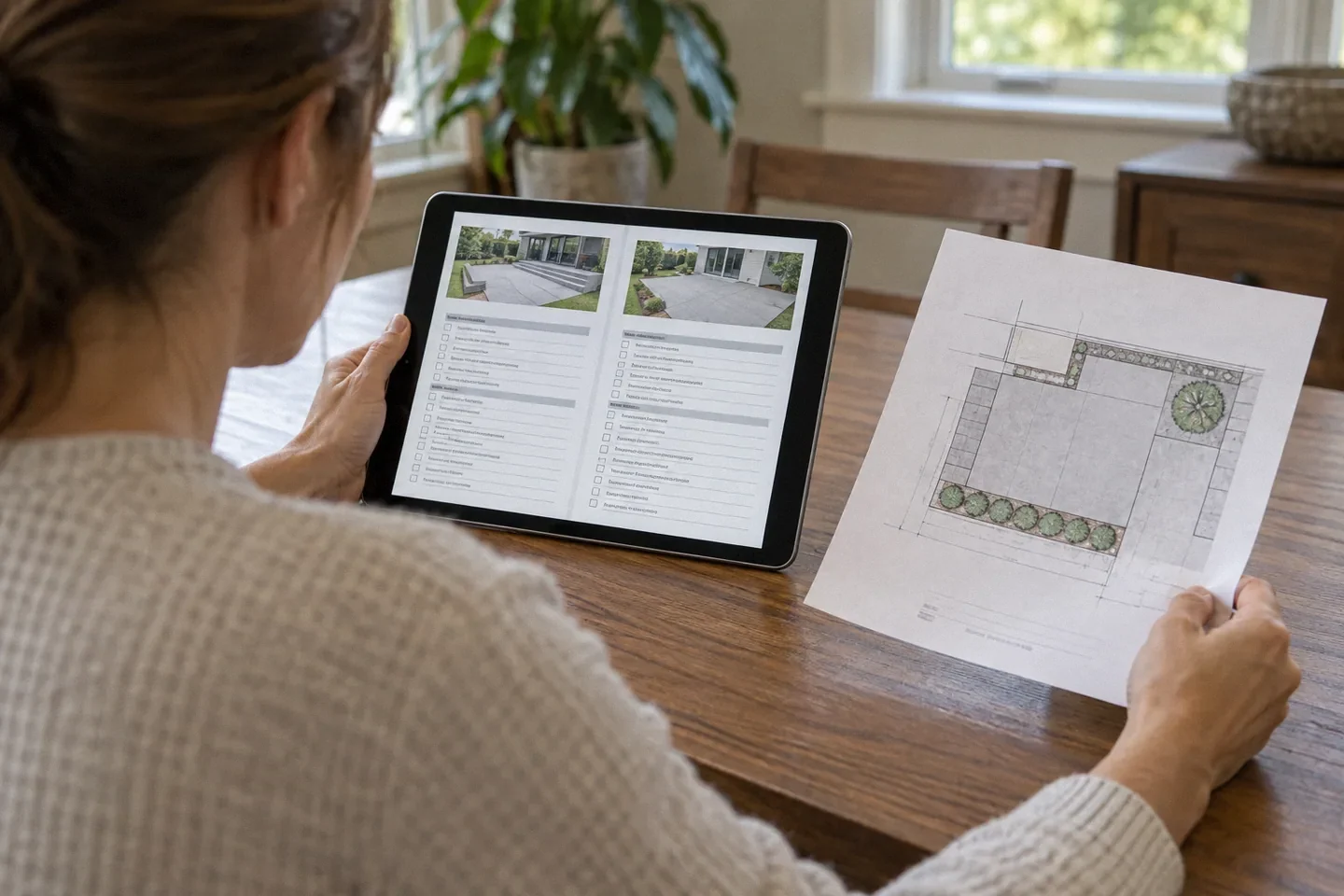
A driveway described as “approximately 800 square feet” may not include the apron, sidewalk crossing or small connector beside the garage. Ask each bidder to mark the included boundaries on the same sketch. Record which existing sections remain, which are removed and where new work joins old work. A shared photograph with numbered areas is often easier to discuss than three differently worded proposals.
Describe how the slab will be used. Passenger parking, equipment storage and a future building are different project briefs. You do not need to invent a mix or reinforcement schedule to ask for a comparable bid. You do need to tell every bidder about the same intended use and identify any plans or professional design that control the work.
The FTC recommends obtaining several written estimates. The comparison method below is a practical way to investigate the differences rather than treating the lowest total as a complete answer.
Split visible work from work that disappears
The finish is easy to compare in a portfolio. Excavation, preparation and reinforcement will be much harder to evaluate after placement. Ask what each contractor actually includes, who specifies it and what happens if the exposed ground differs from the bidding assumptions.
Do not demand an arbitrary thickness or steel layout because another proposal mentions one. Instead, ask the bidders to identify the specification they priced. If the project needs an engineered design, compare prices against that design. Otherwise, ask the local reviewing authority and qualified project professional what documentation is appropriate before treating one method as equivalent to another.
Access can explain a legitimate price difference. One proposal may include a pump, while another assumes a truck can reach the forms. Confirm access restrictions, overhead obstructions, gate widths and surfaces that equipment would cross. Do not agree that a vehicle can use a neighbor's property unless permission actually exists.
A comparison sheet that reveals missing scope
| Item | What to ask each bidder | What an empty answer means |
|---|---|---|
| Existing concrete | Which areas and assumed conditions are included in removal? | Demolition exposure remains unclear |
| Hauling | Are loading, transport and disposal included? | A low total may omit removal costs |
| Ground preparation | What work is priced, and what condition triggers a revision? | Unknown conditions have no defined process |
| Concrete placement | Which plan, mix designation and placement method were priced? | The proposed products may differ |
| Appearance | Which finish, edge treatment and approved sample control? | A photograph may mean different things to each person |
| Completion | Who removes forms, restores disturbed areas and provides records? | The job may end earlier than the owner expects |
Keep “excluded,” “included” and “not answered” separate. An exclusion is information you can price. An unanswered question is uncertainty you still need to resolve. Do not silently count an unanswered item as included just because it seems obvious.
Compare allowances without pretending they are fixed prices
An allowance is a stated budget or quantity assumption, not necessarily a promise that every possible condition costs the same. Ask what is measured, what unit price applies, who verifies quantities and when additional work requires approval. If the contractor cannot define the mechanism, the allowance may be impossible to compare.
Request a revised total for your actual chosen scope. Handwritten mental adjustments such as “this one is probably another thousand for hauling” become unreliable quickly. A revised proposal also lets the contractor correct a misunderstanding before you select a bid on the wrong basis.
A Reddit homeowner's dispute about replacement versus work over an existing pad illustrates the importance of defining the operation. The post is an allegation, not a technical finding, but it asks a useful purchasing question: what exactly does the word “replace” buy?
Hypothetical example: three prices for two different jobs
Suppose an owner receives three patio bids. Bid A includes removal of the old slab and landscape restoration. Bid B includes placement on a prepared area, with removal by others. Bid C includes removal but assumes equipment can enter through a side gate that is too narrow.
The owner first sends everyone the same marked layout and access photographs. Bid B then adds demolition. Bid C revises its access plan. Bid A explains that planting replacement is an allowance rather than unlimited restoration. Only after those revisions does the owner have three meaningful totals.
Nothing in this example proves which contractor is best. It demonstrates why a price ranking can change when the scope becomes consistent. The owner can now evaluate responsiveness, references and the proposed method alongside the actual cost.
Resolve differences before signing
Use one short clarification email rather than a series of verbal corrections. Attach the sketch, list unresolved items and ask the contractor to incorporate the answers into the final proposal. Keep the earlier versions so you can identify what changed, but clearly mark which revision you accepted.
California owners should also review the state's home improvement contract guidance. Its legal requirements are California-specific; they should not be copied into a Florida project as if they were national rules.
Is a higher quote evidence of overcharging?
No. First check whether it includes more work, different access assumptions or a different proposed specification. If the scope is comparable, ask the bidder to explain the remaining difference without assuming either dishonesty or superior quality.
Should I ask every contractor to match the cheapest bid?
Ask for the same defined scope first. A price match that removes preparation, cleanup or another needed item can make the number look better while changing the project you will receive.
Your next useful step is a completed comparison sheet with written answers in every important row. Choose a contractor only after you understand both the priced work and the remaining uncertainty.
Research references
- primary · full
FTC: How To Avoid a Home Improvement Scam - primary · full
CSLB: Terms of Agreement - reddit · search-excerpt
Am I about to get scammed from this concrete contractor? - reddit · search-excerpt
Am I being scammed? Was told this was a $9,500 job to replace and strengthen