- Record where deposits recur
- Trace the moisture pattern
- Test a compatible cleaner
Reddit discussions identify questions; technical guidance comes from the linked primary sources. This article is not a site inspection or an engineered specification. How we research.
Treat the powder as evidence
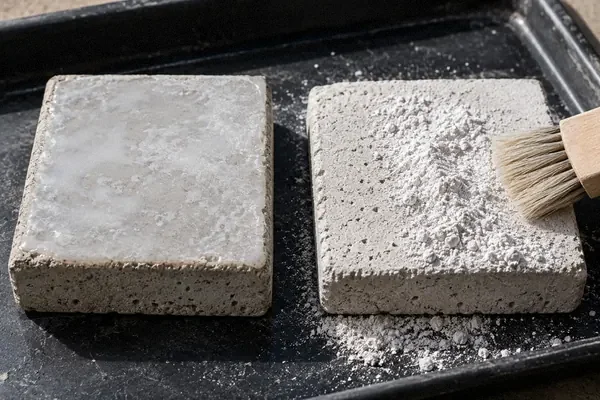
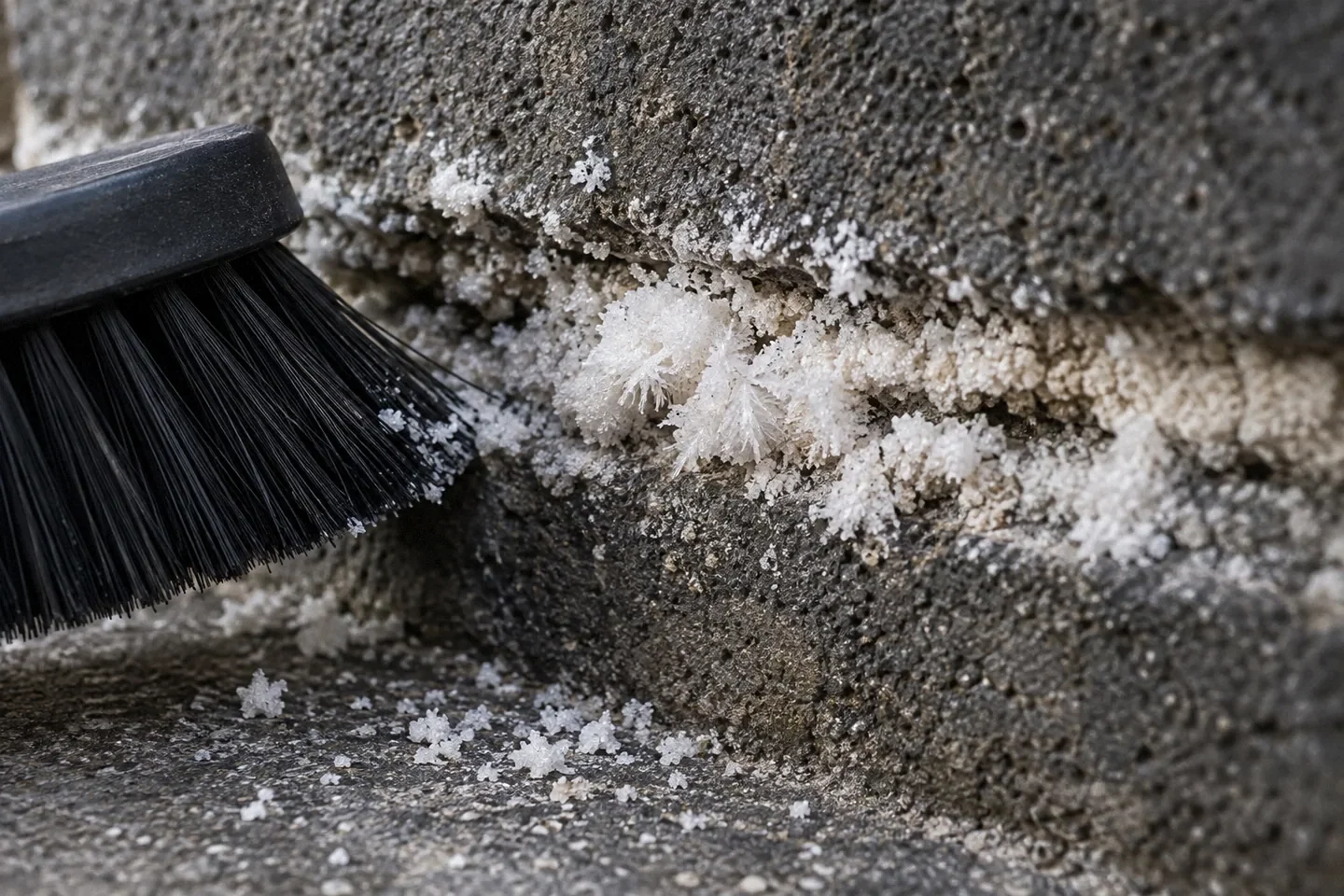
White material on a concrete floor can look fluffy, chalky or crusted. The appearance may prompt concern about mold, deteriorating concrete or a failed coating. Before washing it away, photograph the deposit and its location. Include walls, joints, equipment and nearby drains so the pattern remains understandable after cleaning.
A Reddit homeowner found piles of white material in a below-grade garage where water had appeared after heavy rain. The thread connects a visible deposit with a moisture history worth investigating. It does not establish the identity of every white deposit or prove which route water takes in another building.
Do not taste an unknown deposit or handle it as a home identification test. The useful first information is its location, recurrence and relationship to water, not an improvised chemical experiment.
What efflorescence means
Euclid Chemical explains in its efflorescence technical bulletin that water can carry soluble material through concrete and leave deposits at the surface. This gives you a useful framework: a visible deposit can be linked to transport through the material, not simply dirt landing on top.
That mechanism does not mean every occurrence identifies a leak or a major defect. A new installation and an old floor with repeated water entry present different histories. The assessment should consider those histories before assigning significance to the stain.
Other white appearances can involve hard-water residue, construction dust or a coating problem. PROSOCO's stain identification guide distinguishes several deposit types. Use such guidance to ask better questions, not to declare a final diagnosis from a single visual clue. If the identity matters to the treatment, have it evaluated appropriately.
Map recurrence instead of only photographing quantity
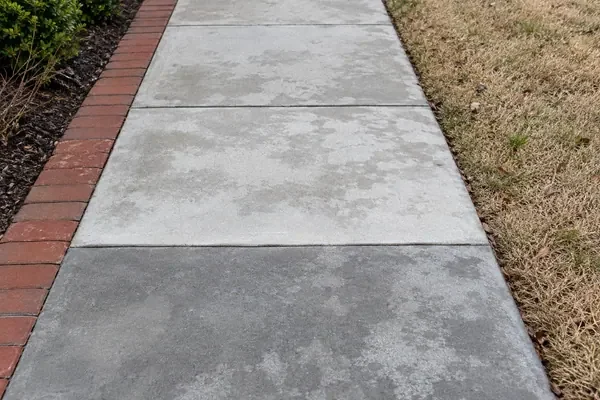
Mark the locations on a simple floor plan. Does the material return beside a wall, around a crack, under stored objects or across the entire area? Record whether it appears after rain, irrigation, washing or a period of closed storage. A repeating location can help direct an investigation even when the total amount varies.
If cleaning is performed, keep a record of the date and method. Photograph the same area afterward and when any material reappears. Without that baseline, it can be difficult to tell whether a treatment failed or whether old residue was never fully removed.
Also record visible water separately from damp-looking concrete. A dark patch is not itself a measurement of moisture movement. Describe what you actually observed: standing water, a wet wall, a recurring dark area or a deposit that returns. Precision helps the evaluator choose the next step.
Look beyond the immediate spot
Review nearby downspouts, grade, irrigation and drainage with the relevant contractor. Indoors, include plumbing or equipment that might contribute water. Do not assume the closest visible feature is the cause. Water can travel along a path that is not obvious from the deposit's final location.
For a floor intended to receive a coating, the moisture question becomes especially important. NRMCA CIP 28 discusses slab moisture and finish-related concerns. A surface that is temporarily dry after cleaning does not answer whether it meets a particular coating system's requirements.
Ask the evaluator to distinguish the immediate cleaning scope from any investigation of moisture. If only cleaning is included, it should not be described as a permanent solution to the underlying condition. That distinction protects both the owner's expectations and the contractor's scope.
Choose cleaning only after checking compatibility
Identify any existing sealer, paint, stain or decorative finish. A product suitable for bare concrete may affect another surface differently. Ask for the cleaner's current data sheet and a small test area. PROSOCO's Light Duty Concrete Cleaner is one manufacturer example intended for specified stains and substrates; its name is not a universal prescription for every white mark.
The cleaning plan should cover application, rinsing, surrounding surfaces and evaluation after drying. Follow the exact product instructions rather than an improvised dilution or internet acid recipe. If the initial trial does not improve the condition, reassess the identification instead of automatically using a stronger treatment.
Do not add a sealer merely to hide the powder. First establish whether the proposed treatment is compatible with the substrate and moisture conditions and what it is expected to accomplish.
Useful information for the site review
- Age and use of the concrete surface.
- Location and recurrence of the deposit.
- Photographs before and after any cleaning.
- Known wetting events or visible water entry.
- Existing coatings and cleaners already tried.
- Changes in nearby drainage or irrigation.
- Planned future coating or flooring.
This concise record is more useful than collecting many product recommendations. It also helps distinguish an isolated appearance concern from a recurring water-management problem.
A hypothetical garage example
Imagine a hypothetical garage where white powder appears behind a storage cabinet after rainy periods. The owner cleans the visible material, then plans to coat the floor. A better sequence documents the recurrence and investigates the moisture history before choosing a finish. Moving the cabinet may reveal the pattern, but it does not establish the water's source.
If the investigation identifies a condition requiring correction, that work becomes part of the plan before the coating's readiness is evaluated. If no ongoing problem is established, the owner still has a documented baseline and can select a compatible cleaning approach. Either outcome is more useful than repeatedly concealing the same unexplained deposit.
Make the next step answer one question
Start with identification and recurrence, then address cleaning and any moisture investigation as separate tasks. Ask what finding would change the plan and when the area will be reviewed again. White powder should lead to a clear record and a suitable response, not an unsupported diagnosis or an endless cycle of washing and resealing.
Related questions
Is white powder always efflorescence?
No. Similar-looking deposits and residues can have different origins, and a photograph is not a definitive identification method.
Will cleaning keep the powder from returning?
Cleaning addresses the visible deposit. Recurrence depends on the source and movement of moisture and soluble material, so the surrounding conditions also matter.
Research references
- primary · search-excerpt
Euclid Chemical Technical Bulletin CP-30: Efflorescence Causes, Prevention, and Removal - primary · search-excerpt
PROSOCO Stain Identification Guide - primary · full
NRMCA CIP 28 - Concrete Slab Moisture - primary · search-excerpt
PROSOCO Light Duty Concrete Cleaner - reddit · search-excerpt
Is this efflorescence? Why has so much of it collected?