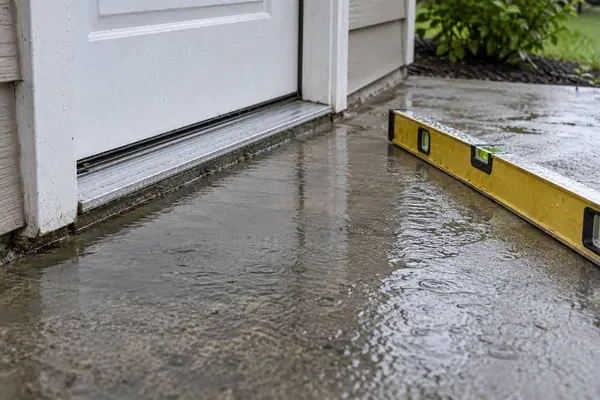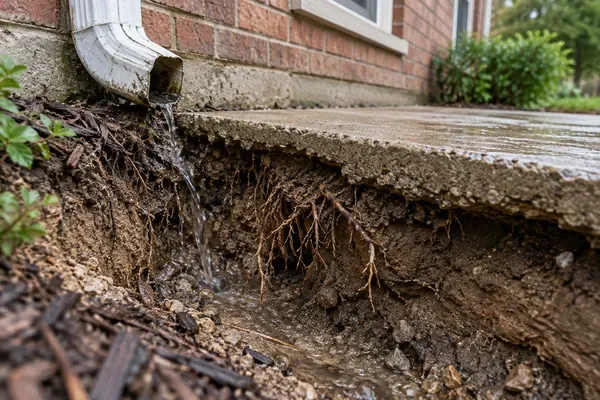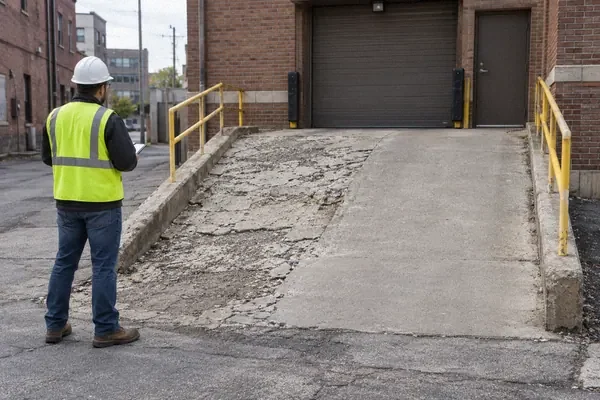
- Identify the receiving area
- Review slab and support conditions
- Compare a defined drainage repair
Reddit discussions identify questions; technical guidance comes from the linked primary sources. This article is not a site inspection or an engineered specification. How we research.
A disappearing puddle is not the only objective
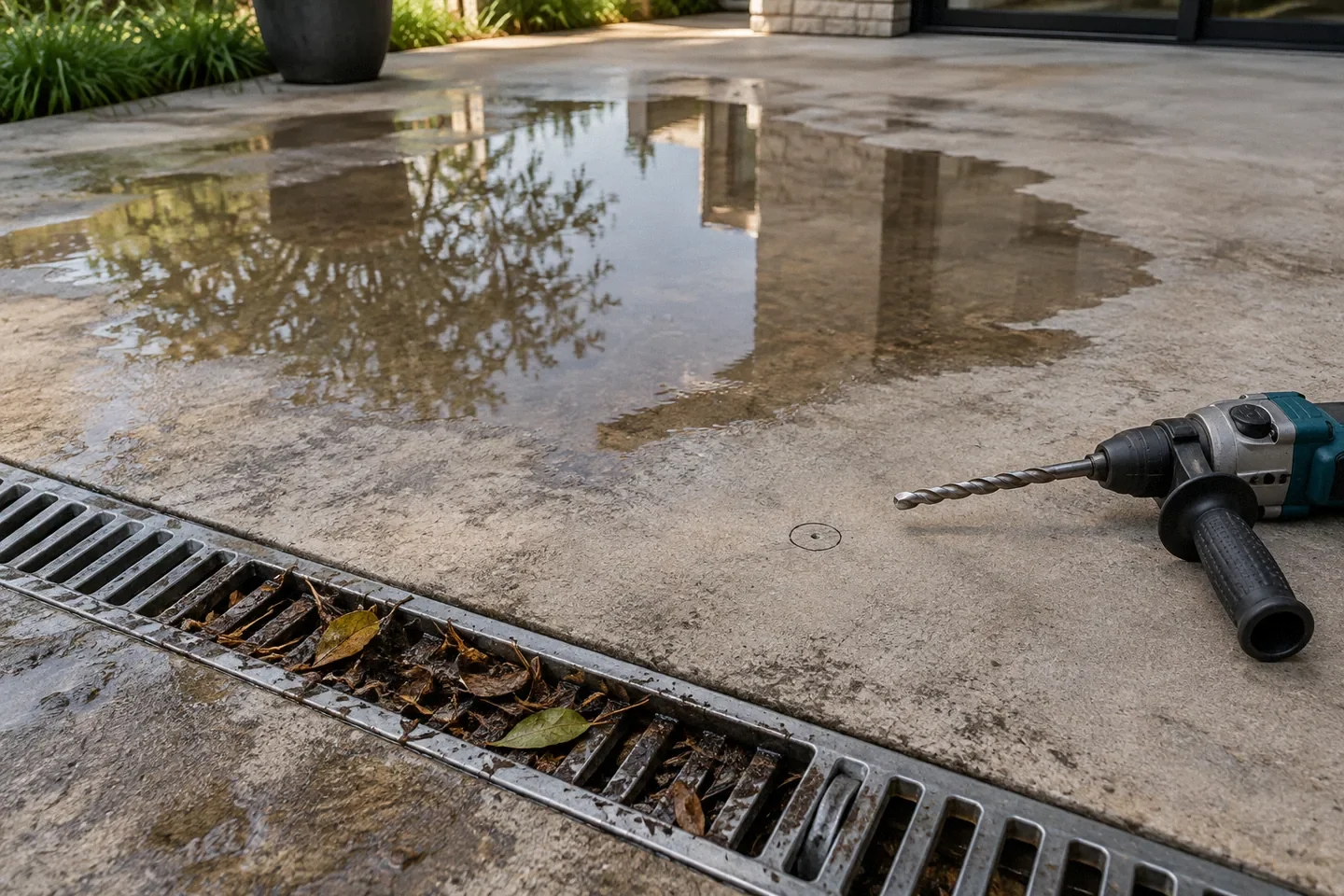
When a patio holds water, drilling a hole seems like a direct solution: give the puddle somewhere to go. The missing question is what happens after the water leaves the surface. It may enter ground or fill that was never intended to receive concentrated runoff, and the owner may have no way to inspect or maintain that path.
A Reddit homeowner proposed drilling through a patio joint to relieve low spots. The question itself recognized the possibility of damage below the slab. That is the right uncertainty to investigate. The comments do not establish whether the receiving soil, base or slab at another property can accommodate the proposed change.
Follow the water beyond the concrete
A drainage proposal needs an inlet, a route and a suitable destination. A hole describes only the inlet. Ask where water would collect below the slab, how it would leave that area and what happens when the ground is already wet. Without those answers, the puddle may simply be moved to a place where its effects are less visible.
Do not assume a gravel layer guarantees drainage. The material around it and the available outlet influence what actually happens. The owner may know that gravel was placed but not its extent or the surrounding soil conditions. Those unknowns should be investigated rather than filled with optimistic assumptions.
NRMCA CIP 4 treats support and drainage as relevant to slab performance. It does not endorse drilling holes as a general patio remedy. The proposed change needs its own site-specific explanation.
Concentrating water can change the exposure
A broad surface receiving rain and a small opening directing water into one point are not the same arrangement. The evaluation should consider the volume and route of water, not only the diameter of the proposed hole. Roof runoff or adjacent paving may add more water than falls directly on the puddle.
Support loss is one concern that can require investigation. The FHWA pavement preservation guide discusses moisture and support conditions in pavement repair. That highway guidance is not a residential drainage design, but it illustrates why the condition beneath concrete matters when water routes are changed.
Avoid claiming that a single hole will definitely undermine a slab. The point is that suitability cannot be established from the puddle photograph. A responsible proposal identifies the receiving conditions and explains why the intended system is appropriate.
The slab itself has constraints
Before any drilling or cutting, establish the slab's function and what may be embedded in it. A ground-supported patio, a garage roof deck and a structural slab require different treatment. Unknown post-tensioning, reinforcement or services are reasons to obtain appropriate information before invasive work.
A control joint also has an intended purpose. It should not be treated as a convenient drain location merely because it is already a line in the surface. Ask whether the proposed alteration affects the joint detail and how the opening will be maintained.
Do not use this article as a drilling instruction. There is no universal safe hole location, diameter or depth for the variety of concrete installations that homeowners call patios.
Diagnose the low area first
Map the puddle, the surrounding high points and the intended drainage edge. An elevation review may show a local depression, a blocked route or a broader backward slope. These conditions can lead to different solutions, and a hole bypasses that diagnosis rather than answering it.
Ask whether the problem existed from placement or developed later. If the slab moved, the cause of movement may still need attention. A drain that removes visible water does not establish that the slab has stopped settling.
Also document the effect on use and the building. Water beside a door or wall raises different practical concerns from a small isolated low spot away from structures. The review should reflect those consequences.
Compare methods by the complete route
| Proposal | Information needed before approval |
|---|---|
| Surface correction | Feasible elevations, material limits and finished outlet. |
| Channel or drain | Collection route, discharge point and maintenance access. |
| Slab lifting | Suitability of the slab and treatment of the movement cause. |
| Replacement | Revised grading, support and joint plan. |
| Drilled opening | Receiving conditions, structural constraints and long-term function. |
The final row is deliberately demanding. A drilled opening should not receive less scrutiny merely because it is cheaper and quicker to create.
A hypothetical low corner
Imagine a hypothetical patio with a puddle near one corner. The owner plans to drill through the center of the wet area. A site review finds that the corner is low because the adjacent edge is slightly higher and the intended outlet is obstructed. A suitable correction to the route may solve the surface problem without sending water below the slab.
In another case, the low area may reflect settlement near concentrated roof runoff. The repair then needs to address the runoff and support conditions. A hole in that location could leave the original cause untouched. Similar puddles do not imply the same remedy.
Require maintenance and verification details
Any drainage system needs a plan for debris, access and review. Ask how the proposed route can be inspected and what happens if it stops accepting water. An inaccessible opening that worked once during a demonstration may not be a satisfactory long-term result.
Agree on how the completed work will be checked and keep the original puddle map. The objective is not merely to make water vanish from a photograph. It is to provide a suitable, maintainable route that addresses the low area without leaving important support or building questions unresolved.
Choose a designed correction
Contact the installer or an appropriate drainage contractor with the map and observations. Ask for a complete explanation of water's destination before authorizing a hole or cut. A small intervention can be sensible when properly evaluated, but small size does not replace design. Resolve the receiving conditions and slab constraints first, then choose the repair.
Related questions
Can I drain a puddle through the control joint?
A joint is not automatically a designed drain. Sending water below the slab requires evaluation of the receiving conditions and potential consequences.
Would one small hole be harmless?
Hole size alone does not establish suitability. The slab's role, embedded items, water volume and receiving ground all matter.
Research references
- primary · full
NRMCA CIP 4 - Cracking Concrete Surfaces - primary · search-excerpt
FHWA Concrete Pavement Preservation Guide, Second Edition - reddit · search-excerpt
Pooling on patio