- Locate the joint on a sketch
- Confirm its intended function
- Choose a compatible repair detail
Reddit discussions identify questions; technical guidance comes from the linked primary sources. This article is not a site inspection or an engineered specification. How we research.
The name changes the repair conversation
A homeowner asks how to fill an expansion joint and receives a dozen product recommendations. Yet the photograph may show a contraction joint, a construction boundary or a crack beside a building. The first missing item is not a product name. It is an understanding of what the line was designed to do.
In a Reddit discussion about sealing formed joints, the conversation moved between hairline cracks, epoxy and the grooves dividing a driveway. That confusion is common. It matters because a repair selected for one purpose can interfere with another. The discussion provides a useful question to investigate, but its comments should not be treated as a specification.
Three functions to distinguish
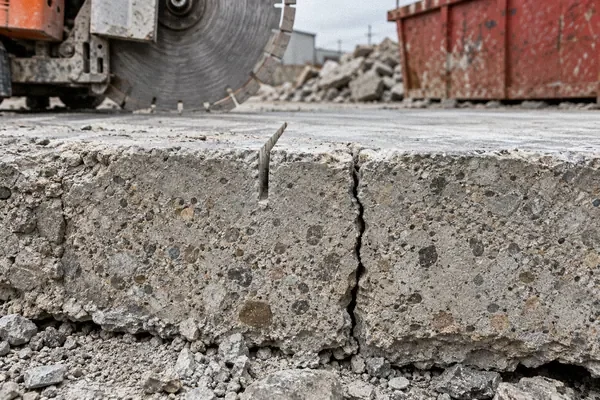
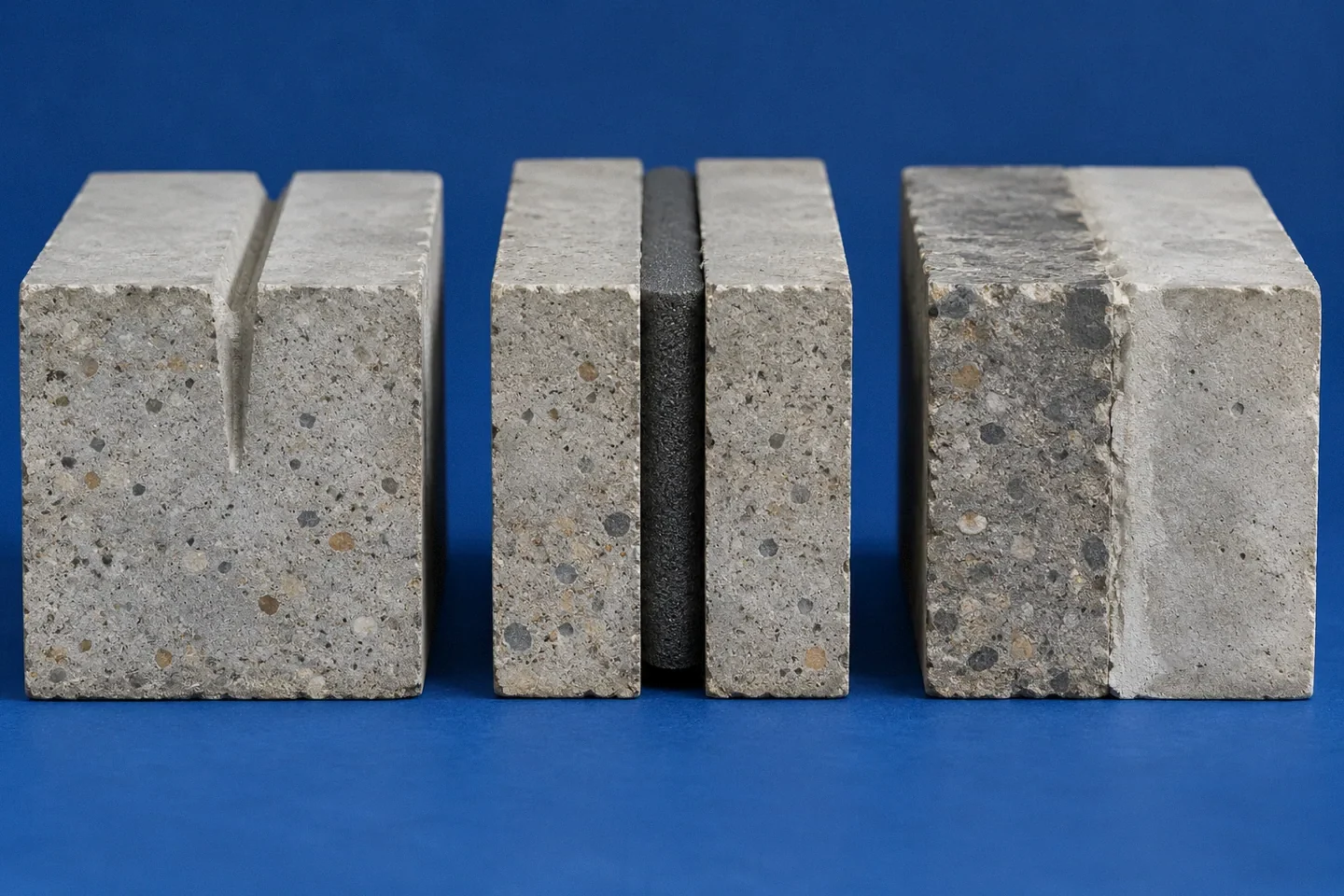
NRMCA explains the major joint types in CIP 6, Joints in Concrete Slabs on Grade. A contraction joint helps determine where movement-related cracking occurs. An isolation joint separates a slab from another element so they can move independently. A construction joint marks where successive concrete placements meet and may have a project-specific connection or load-transfer detail.
Those short definitions are a starting point. They do not reveal the complete design of a particular joint. A boundary between pours can have details beneath the surface that are not visible in a photograph. Likewise, an old repair may conceal the original joint material. When the proposed work depends on those details, obtain the drawings or an appropriate assessment rather than guessing.
The word expansion is sometimes used broadly in everyday conversation. You do not need to correct every casual use to have a productive discussion. Ask the contractor to identify the intended function and proposed repair detail in writing so both parties are referring to the same thing.
Use location and history as clues
Start with a plan-view sketch of the slab. Mark the building, stairs, columns, adjoining concrete and the lines you are considering repairing. Note whether the lines form regular panels or follow a boundary. Add the dates of separate pours if known. This gives the contractor more information than a close view of a single gap.
Look for existing filler or sealant, but avoid pulling it out without a plan. Record whether the material is missing, cracked, loose or simply dirty. The condition of a surface sealant is not automatically the condition of the concrete below. An inspection may need to distinguish those layers.
Construction photographs can be especially useful when a joint's internal detail is unclear. Ask whether the original installer has them. If none exist, say that the detail is unknown. Do not infer that two slabs are tied together merely because the surfaces meet closely, or that they are fully isolated because a visible line separates them.
Repair materials need a defined job
A surface sealant, a compressible filler and a material intended to support joint edges are not interchangeable simply because they occupy a gap. Ask what the proposed material is supposed to do under movement and traffic. The contractor should connect that explanation to the joint's function and the manufacturer's requirements.
For example, Sika's self-leveling sealant guidance describes a particular horizontal-joint application and preparation conditions. It should not be generalized into a rule that the same product belongs in every line on every slab. Orientation, expected movement, exposure and substrate condition affect suitability.
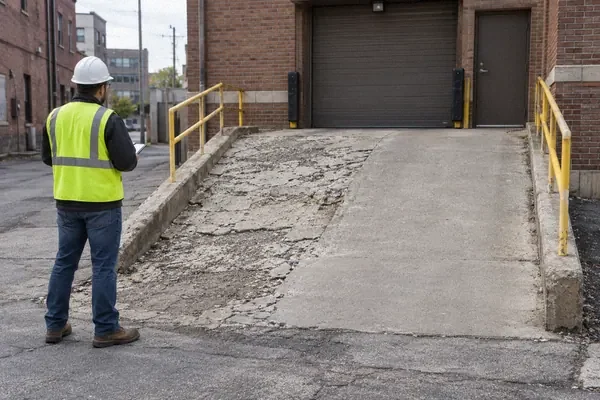
If an interior floor carries hard-wheeled traffic, ask specifically how the joint edges will be protected. If an exterior joint is next to a building, ask how it relates to the water-management detail. These are different service conditions. A repair proposal that ignores them is incomplete even if the material itself is reputable.
A comparison to use during a site visit
| Observed situation | What to establish before repair |
|---|---|
| Regular groove across a driveway panel | Whether it is a contraction joint and how movement is accommodated. |
| Separation beside a wall or column | Whether an isolation detail exists and must be preserved. |
| Boundary between pours | Whether there is a connection or load-transfer detail. |
| Broken edge beside a joint | Whether sound concrete must be restored before filling. |
| Repeatedly failed surface material | Whether geometry, preparation or movement is defeating the repair. |
This table does not identify the joint for you. It helps keep the investigation focused on the information that can change the repair choice.
A hypothetical mixed-joint driveway
Imagine a hypothetical driveway with regular saw cuts, a boundary where an extension was added, and a separation at the garage. The owner plans to buy one rigid filler for all three because the gaps look similar from a distance. A site review identifies different functions and an unknown connection detail at the extension.
The resulting scope may use different treatments or leave some areas pending further review. That is not needless complication. It prevents a single convenient material from being applied where its role has not been established. The owner can then compare bids using the same joint map instead of comparing only the number of cartridges or linear feet.
Preserve the joint's purpose
Before authorizing the work, ask for a marked layout, the treatment for each joint type and the expected finished appearance. Clarify whether existing material will be removed, whether damaged edges are included, and how the repair will be maintained. Keep those details with the product information. The objective is a joint that continues to serve its intended function, with a repair suited to its condition and use, rather than a uniformly filled set of lines whose purposes remain unknown.
Related questions
Is every gap an expansion joint?
No. Homeowners often use that name for several joint types, but the intended function should be confirmed before repairs are specified.
Can I identify a joint only by its width?
Width alone is insufficient. Location, depth, construction history and the original detail can all help identify its purpose.
Research references
- primary · full
NRMCA CIP 6 - Joints in Concrete Slabs on Grade - primary · search-excerpt
Sikaflex Self Leveling Sealant - reddit · search-excerpt
Should I seal cracks in control joints that were formed during pouring?