- Review combined weather conditions
- Match delivery to crew capacity
- Stage protection before placement
Reddit discussions identify questions; technical guidance comes from the linked primary sources. This article is not a site inspection or an engineered specification. How we research.
A forecast above 100 degrees can make an owner wonder whether the scheduled pour should be canceled. A milder forecast can create false reassurance if the site is windy, exposed, and dry. The decision needs to consider more than one weather number.
A Reddit homeowner facing a heat wave asked whether to postpone or simply keep the slab wet. The useful response is to review the contractor's complete plan, including what happens before placement, during finishing, and immediately afterward.
Identify the combined conditions
NRMCA CIP 12 describes hot-weather concreting through interacting factors including air and concrete temperatures, humidity, wind, and solar exposure. This explains why two sites with the same forecast can behave differently.
Walk the actual work area. Note which portions receive direct sun, whether nearby structures create shade, and where wind crosses the surface. Ask how those differences affect the planned sequence.
The forecast should inform preparation, but someone also needs to monitor conditions on the day. An early-morning plan can change if delivery is delayed into the afternoon.
Start with the mixture and delivery discussion
Tell the producer the application, placement method, expected duration, and conditions. Ask what mixture provisions are appropriate under the project specification.
Do not independently prescribe an admixture dose or assume that a retarder solves every hot-weather problem. The mixture should be selected with the producer and coordinated with the crew's finishing plan.
Confirm truck spacing and discharge access. A delayed load waiting while the crew struggles with equipment is a different situation from a planned continuous operation. The schedule should reflect actual placing capacity.
Separate labor bottlenecks from chemistry
Count the people required for placing, screeding, detail work, finishing, and protection. A small crew cannot simply move faster indefinitely as conditions become more demanding.
Identify the most constrained step. It may be transport through a gate, a pump setup, or handwork around several obstructions. Improving that step can be more important than changing the delivery time alone.
If the plan relies on one person switching among incompatible simultaneous tasks, resolve the staffing issue before the pour. Weather controls do not create extra hands.
A hypothetical afternoon delay
Suppose a patio is scheduled for an early morning placement. Forms and access are ready, and the contractor expects to finish before the hottest part of the day.
Dispatch then reports a substantial delay. The original plan's assumptions have changed. The crew should reassess sun exposure, concrete supply, finishing capacity, and protection rather than treating the start time as a minor administrative detail.
The decision might be to proceed with appropriate adjustments, reduce or revise the planned operation through an approved sequence, or reschedule. What matters is that the choice is made from the new conditions and resources, not from pressure to preserve the calendar.
Have surface protection ready
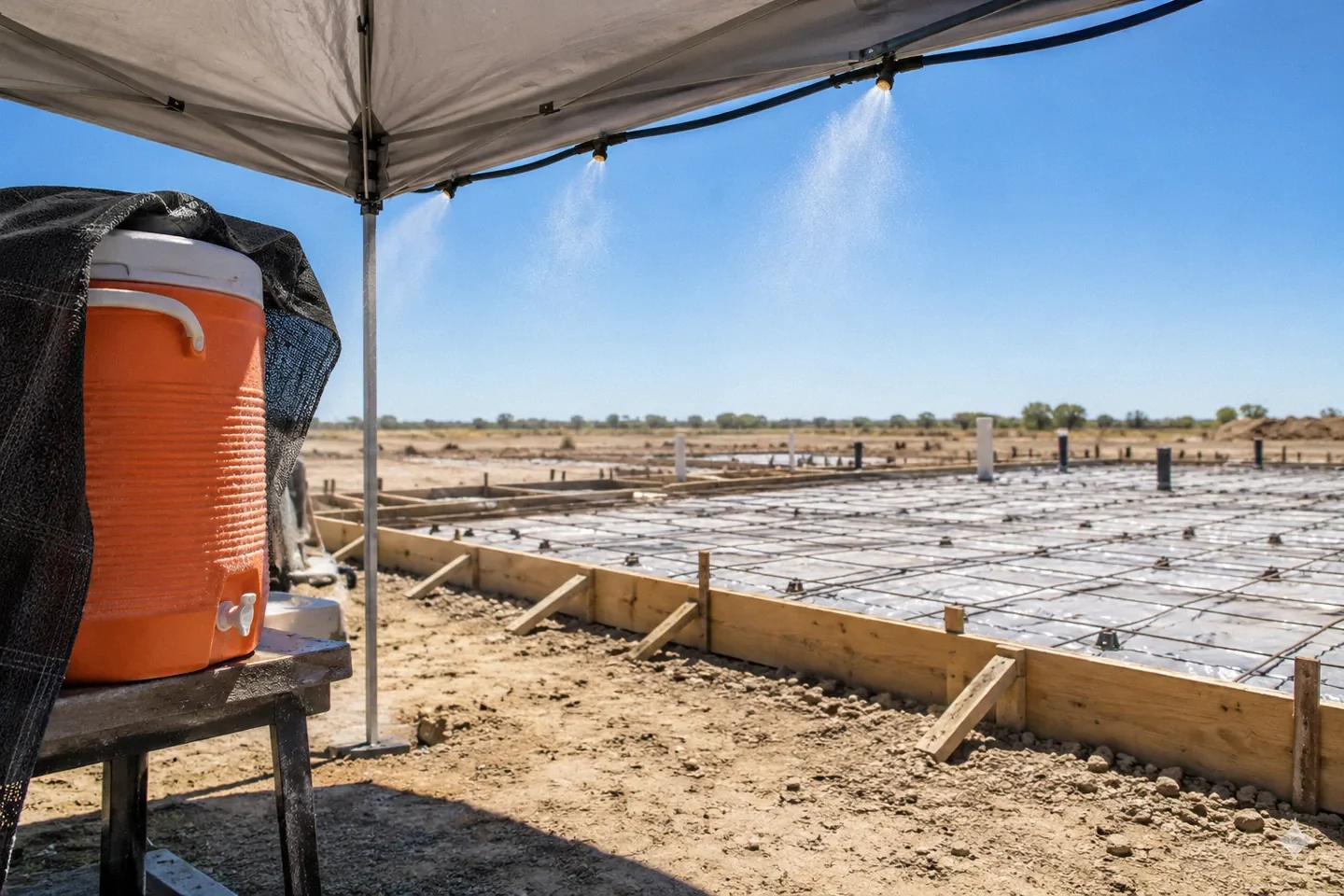
The period before final curing begins can require its own measures. Discuss the appropriate method with the installer and product guidance, including any shade, wind control, fogging, or evaporation-control system proposed.
These methods are not interchangeable with sprinkling water onto the surface to aid finishing. NRMCA specifically cautions against that finishing shortcut.
Once finishing is complete, the selected curing system should be ready to begin as appropriate. Do not wait until the surface is finished to find covers, water access, or the specified curing material.
Build a go-or-reschedule checklist
| Item | Ready to proceed means |
|---|---|
| Weather | Combined conditions have been reviewed |
| Mixture | Producer and project requirements are aligned |
| Delivery | Access and truck spacing fit the operation |
| Crew | Placing, finishing, and protection roles are covered |
| Equipment | Critical tools are on site and working |
| Protection | Materials and application responsibilities are ready |
| Delay response | Someone can reassess changed conditions |
The checklist does not create a universal numerical cutoff. It makes the team's assumptions visible and identifies missing controls.
Do not confuse wet appearance with a complete curing plan
A slab that looks damp at one moment has not necessarily received the planned protection over the required period. Ask who maintains the curing method and how continuity is checked.
For a homeowner assigned part of the curing responsibility, obtain clear written instructions specific to the chosen method. Resolve access and schedule constraints before accepting that role.
If a product is used, retain its name and instructions. Future decorative or flooring work may need to know what was applied.
Communicate changes through one person
Assign a site contact who can coordinate with dispatch and the installer. Conflicting instructions about water, admixtures, or delivery timing can undermine an otherwise organized plan.
Record significant delays and authorized adjustments. These notes provide context if questions arise later, without pretending to diagnose a finished slab from weather alone.
An owner should ask for the plan rather than attempt to direct every tool pass. The installer should be able to explain how the operation responds to the expected conditions.
Make the decision before the crew is committed
Review the plan while rescheduling or rearranging resources is still practical. Waiting until the first truck is discharging narrows the available choices.
The next step is to ask: “What conditions are you planning for, what controls are ready, and what change would make you reassess?” A specific answer is more useful than either “heat never matters” or “never pour above this temperature.”
Frequently asked questions
Is there one maximum air temperature for every pour?
No. Apply the actual specification and evaluate the combined conditions and controls.
Should I spray water to make finishing easier?
Do not use surface water as a finishing shortcut. Distinguish the appropriate protection and curing methods from attempts to make tools move more easily.
Research references
- primary · full
NRMCA CIP 12 Hot Weather Concreting - reddit · search-excerpt
Pouring concrete during heat wave