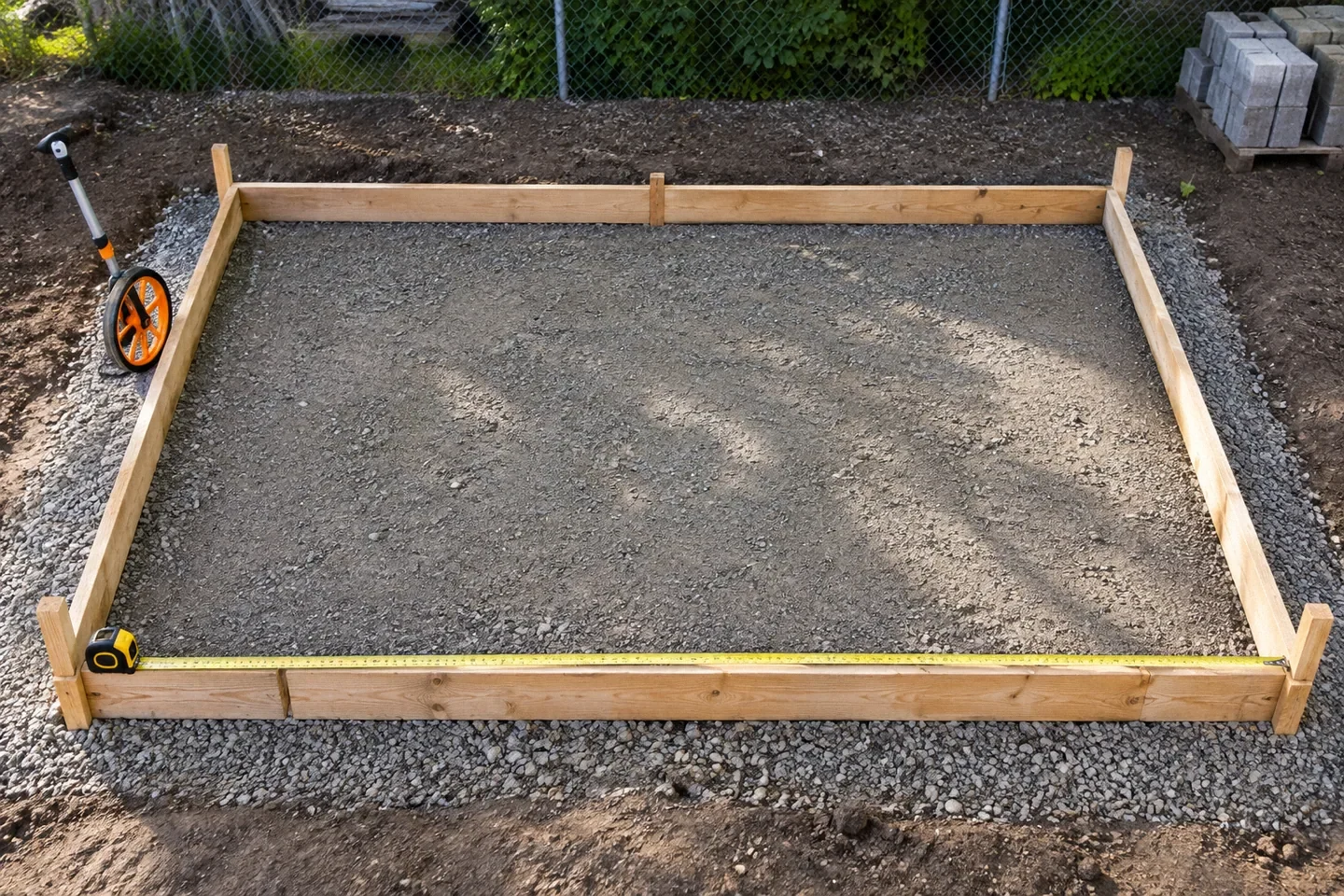
- Measure finished form volume
- Identify extra depth and losses
- Confirm final load with plant
Reddit discussions identify questions; technical guidance comes from the linked primary sources. This article is not a site inspection or an engineered specification. How we research.
A concrete order starts with geometry, but the final quantity is a construction decision. The forms may be slightly wider than the drawing. The prepared base may contain low areas. A thickened edge may have been omitted from the calculator. Small differences become meaningful when multiplied over a large area.
In a Reddit thread about running short near the end of a pour, the owner asked whether professionals normally order extra. The useful lesson is to separate the calculated volume, the measured site conditions, and the contingency instead of hiding all three inside an unexplained round number.
Calculate the shape that will actually be filled
For a rectangular slab, multiply length, width, and thickness in consistent units. If the dimensions are in feet and the thickness is in inches, divide the thickness by 12 first. Divide cubic feet by 27 to obtain cubic yards.
Break an irregular shape into simple pieces. Calculate each rectangle, triangle, or other identifiable portion and add them. Keep thickened edges, steps, and separately formed features visible as their own line items. This makes it easier for another person to find a missing component.
A calculator cannot tell whether your thickness measurement represents the whole slab. Measuring only at the form edge can miss a depression in the middle. Check multiple locations using the intended finished surface as the reference.
A hypothetical quantity example
Suppose a rectangular patio measures 20 feet by 12 feet and is intended to be four inches thick. The geometric volume is 20 × 12 × 4/12, or 80 cubic feet. Dividing by 27 gives approximately 2.96 cubic yards before contingency.
Now imagine the base averages half an inch lower than intended. The additional volume is 20 × 12 × 0.5/12, or 10 cubic feet. That is approximately 0.37 cubic yard, already more than a casual rounding from 2.96 to 3.0 would cover.
This example does not prescribe a patio thickness. It shows why grade accuracy matters to ordering. If the extra depth is unintended, correcting the base may be the right action. Ordering more material without examining the grade can conceal an unresolved preparation problem.
Add an allowance for identified uncertainty
NRMCA CIP 8 describes yield discrepancies and discusses a 4–10% allowance for waste, over-excavation, and other contingencies. Treat that as guidance to examine the work, not a promise that any project will fit one percentage.
List the sources of uncertainty before selecting the allowance. An accurately formed, measured slab differs from an excavation with irregular sides. A short direct discharge differs from a complicated transfer route. Repeated placements with recorded quantities provide more information than a first attempt.
| Quantity component | How to establish it | Common omission |
|---|---|---|
| Main slab | Measured area and thickness | Using drawing dimensions without checking forms |
| Thickened areas | Separate measured geometry | Counting only the flat field |
| Grade variation | Checks across the footprint | Assuming the center matches the perimeter |
| Placement losses | Review the handling method | Ignoring material left in equipment |
| Contingency | Explicit allowance | Rounding without explaining why |
Avoid adding the same contingency twice. If a low area has already been measured into the base volume, do not describe it again as an unknown thickness allowance.
Ask about order increments and the last load
Suppliers may have delivery increments, minimum quantities, and small-load charges. Ask for those terms when arranging the job. A mathematically precise quantity is not necessarily an available order size.
For a multi-load placement, establish who estimates the remaining requirement and who calls the plant. That estimate needs to happen while the supplier still has time to respond. Waiting until the last truck is empty converts an ordinary quantity adjustment into a scheduling problem.
For a small single-load pour, there may be less opportunity to adjust midstream. Preparation and a sensible contingency become more important. Also identify an approved way to handle surplus concrete. Do not improvise disposal into drains, landscaped areas, or an unplanned structural feature.
A shortage is evidence to investigate
Running out does not by itself establish that the supplier under-delivered. NRMCA distinguishes the volume of fresh concrete supplied from the apparent volume of the finished work. Form movement, excess depth, and other losses can matter.
Keep the original calculation, order confirmation, delivery tickets, and notes about changes made during placement. If a genuine yield issue is suspected, discuss the appropriate measurement and testing process with the supplier or project professional. Guessing from photographs is not equivalent to testing delivered yield.
The same discipline applies to a large surplus. Recheck dimensions and the assumptions used for the order. Record what happened so the next placement benefits from actual experience rather than repeating the same unexplained percentage.
Make the order reviewable
Before calling the plant, prepare one page showing measured dimensions, separate features, calculated volume, contingency, and requested quantity. Have someone compare that page with the forms.
Confirm access and the planned discharge method at the same time. An accurate quantity cannot rescue a pour that lacks the equipment or people to place it.
The final question is not simply “How many yards?” It is “Which measured conditions support this quantity, and what uncertainty remains?” That produces a more defensible order and a clearer conversation if the actual consumption differs.
Frequently asked questions
Should I always add exactly ten percent?
No. Use measured conditions and an explicit contingency. The supplier's available increments and your placement plan also affect the final order.
Does running short prove that the truck contained too little concrete?
No. First compare actual geometry and losses with the estimate. Delivered-yield questions require appropriate records and measurements, not the shortage alone.
Research references
- primary · full
NRMCA CIP 8 Discrepancies in Yield - reddit · search-excerpt
Is it industry standard to order extra concrete? These guys didn’t.