- Separate PSI from thickness
- Identify loads and exposure
- Compare complete slab proposals
Reddit discussions identify questions; technical guidance comes from the linked primary sources. This article is not a site inspection or an engineered specification. How we research.
A quotation offering “stronger concrete” can sound like a simple upgrade. Yet two bids may change several things at once: compressive strength, thickness, reinforcement, base preparation, and finish. If you compare only the PSI number, you may pay for the wrong difference or overlook a more important one.
A Reddit homeowner comparing 3000- and 4000-PSI proposals also faced different slab thicknesses. That is a useful buying problem, but it cannot be answered by declaring one number best for every driveway and patio.
What the strength number describes
Specified compressive strength is a material-performance requirement, normally associated with a stated testing age. It is not a direct rating of how much a complete driveway can carry. NRMCA CIP 35 explains compressive-strength testing and why the test conditions matter.
For a buyer, the immediate question is whether both proposals are quoting the same requirement and age. A vague “high strength” description is harder to compare than a written specification. Ask whether the quoted mixture meets all project requirements, including exposure-related ones, rather than focusing on strength in isolation.
Do not treat an anecdotal test, surface scratch, or visual appearance as proof that the supplied concrete reached a particular PSI. Those observations answer different questions from standardized strength testing.
Thickness changes the slab, not merely the mixture
A thicker slab uses more material and changes the geometry of the element carrying loads. Whether a particular thickness is appropriate depends on the entire design and the site. This article does not establish a universal residential minimum.
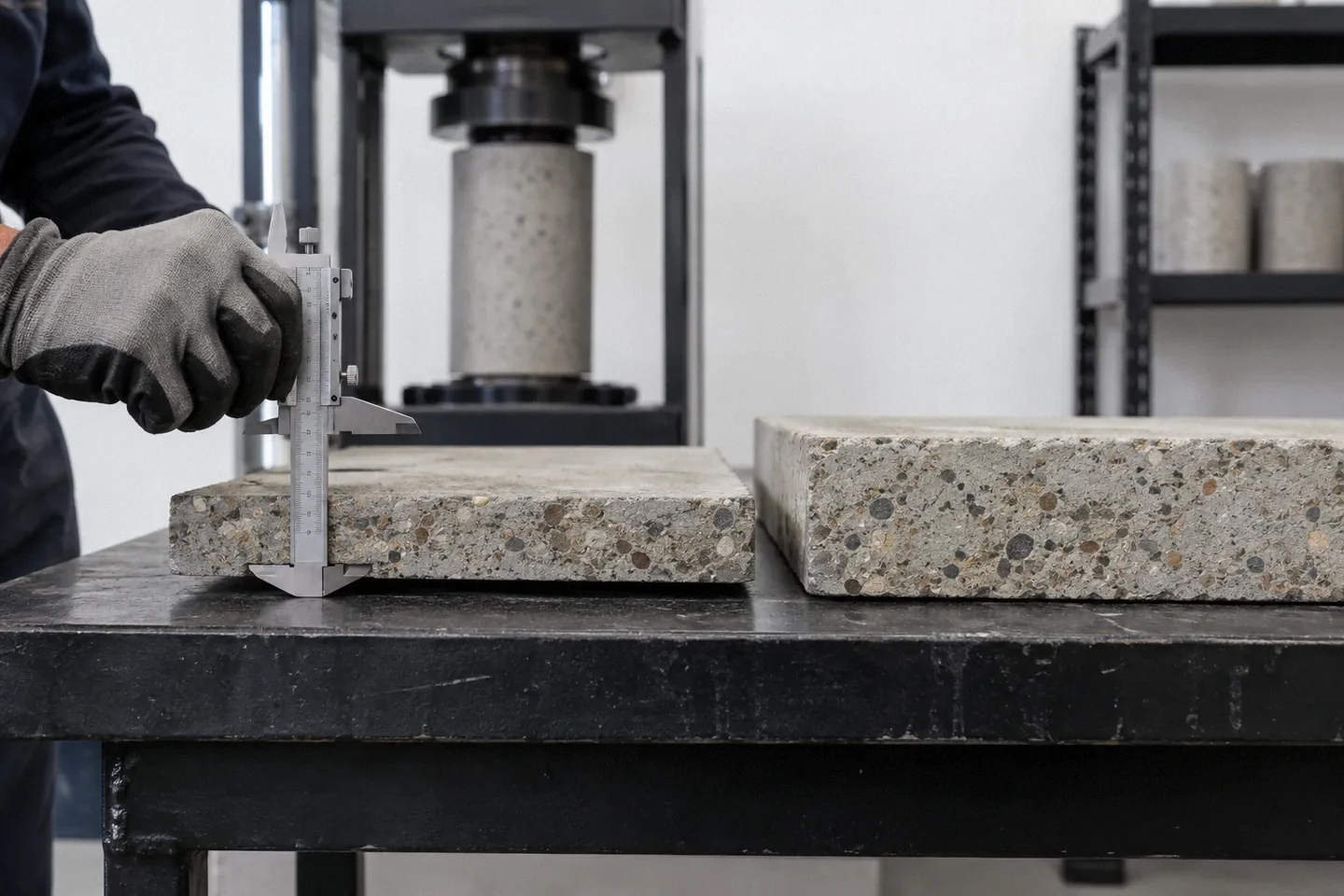
Compare the specified thickness with the intended measurement method. Does the bid mean a nominal thickness, a minimum thickness, or a vague form-board height? An edge measurement alone does not describe the center if the base elevation varies.
For the same plan area, increasing thickness from four to five inches increases geometric concrete volume by 25%. That arithmetic is useful when discussing price, but it does not mean the entire project price should increase by exactly 25%. Excavation, disposal, labor, delivery, and other costs do not necessarily change in the same proportion.
Define what will use the surface
Write down anticipated users and vehicles. A walking patio, passenger-car driveway, delivery access, and equipment pad are different applications. Avoid designing for a vague phrase such as “normal use” when the actual plan includes heavier vehicles.
Consider edges and transitions too. The location of repeated wheel loads and the support beneath those locations can matter to the design discussion. If a contractor assumes cars only while the owner expects moving trucks, the disagreement should be resolved before comparing mixtures.
NRMCA's ready-mix ordering guide connects mixture requirements to loads, environmental exposure, and service conditions. It supports a project-based specification rather than a universal recipe.
Compare bids on the same basis
Build a short comparison sheet. Leave unknowns marked unknown instead of filling them with assumptions.
| Proposal item | Question to resolve |
|---|---|
| Strength | What specified strength and age are included? |
| Thickness | What thickness is promised and how is it checked? |
| Support | What preparation and unsuitable-material work are included? |
| Reinforcement | What exact system, location, and supports are specified? |
| Joints | Who designs the layout and performs the work? |
| Exposure | What weather and moisture conditions are considered? |
| Curing | What method and responsibility are included? |
A lower bid may omit work; a higher bid may include it. Alternatively, both may be complete but use different design assumptions. The sheet makes that difference visible.
A hypothetical driveway comparison
Suppose one proposal lists four inches and 3000 PSI, while another lists five inches and 4000 PSI. The second price is higher, and the owner assumes all of the increase buys stronger concrete.
On review, the first proposal also excludes removal of unsuitable soil and says nothing about delivery access for heavy vehicles. The second includes a clearer support-preparation allowance but still lacks a joint layout. The correct next step is to align the scope and intended use, not calculate a cost per additional PSI.
Now imagine both contractors price the same approved slab design. Their mixture proposals can be checked against that design, and differences in labor, access, and finish can be considered more fairly. A comparable specification makes price comparison more useful.
Avoid three misleading shortcuts
First, do not equate sack count with a guaranteed strength across every mixture. Mixture constituents and proportions vary, and a local shorthand is not a complete performance specification.
Second, do not assume reinforcement excuses weak or inconsistent support. Ask about both systems separately. A well-documented reinforcement plan does not tell you what lies beneath the slab.
Third, do not use higher PSI as permission to omit curing or rush loading. Construction and protection remain part of achieving the intended result. The mixture ordered and the slab ultimately built are connected but not identical facts.
Make the upgrade decision explicit
Ask the contractor to identify what problem the proposed upgrade addresses. Is it a design requirement, a durability requirement, an anticipated load, or a preference for a mixture the crew handles well? Different reasons justify different evidence.
For structural or unusual loading questions, obtain the appropriate design input. For routine procurement, ask the supplier to confirm that the selected mixture meets the written requirements. Keep those roles clear.
Approve a complete slab proposal with defined loads, thickness, support, joints, and curing. A strength number belongs in that proposal; it should not replace it.
Frequently asked questions
Is 4000 PSI always worth paying for?
The answer depends on the requirements and what else changes. A higher number does not automatically correct omissions elsewhere in the slab plan.
Can stronger concrete compensate for a thinner slab?
Do not make that substitution by intuition. Have changes evaluated against the project's design and intended loading rather than assuming material strength and thickness are interchangeable.
Research references
- primary · search-excerpt
NRMCA CIP 35 Testing Compressive Strength - primary · full
NRMCA CIP 31 Ordering Ready Mixed Concrete - reddit · search-excerpt
PSI Rating and slab thickness.....should I spend the extra